
(1863-1935)
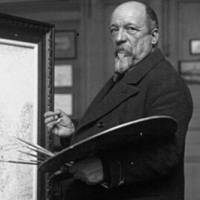
Portrait de Paul Signac par l'Agence Meurisse, 1923 - Domaine public, Bibliothèque nationale de France
Paul Signac was born in Paris on November 11, 1863, and died there on August 15, 1935. Together with Georges Seurat, he created Neo-Impressionism, painting with small, separate strokes of pure color. He co-founded the Société des Artistes Indépendants, led it as president from 1908, wrote the manifesto From Eugène Delacroix to Neo-Impressionism (1899), and became a major watercolorist. In print, his output is small, roughly twenty sheets cataloged by Kornfeld and Wick, but his color lithographs from the 1890s are among the most sought-after fine art prints of the period.
Le Coin des Arts follows Signac’s work and offers his original prints when strong impressions become available, selected for printing quality, condition, provenance, and a clear catalog reference. Want to know when one comes in? Just “follow the artist” on this page.
Signac’s well-to-do family expected him to become an architect. Seeing Claude Monet’s first solo exhibition in June 1880 changed his plans. He started painting in 1881 with no formal training, rowing on the Seine in a boat he called Manet-Zola-Wagner, and from 1882 spent summers painting the harbor of Port-en-Bessin in Normandy. In 1884 he helped launch the Indépendants and met Georges Seurat; the two developed the divided touch that critic Félix Fénéon named “Neo-Impressionism.” Thanks to Camille Pissarro, both showed in the eighth and final Impressionist exhibition in 1886. Signac also painted alongside Vincent van Gogh at Asnières in 1887 and visited him in Arles in March 1889.
Seurat’s death in 1891, at only thirty-one, left Signac in charge of the movement. In 1892 he followed Henri-Edmond Cross south, discovered Saint-Tropez, married Berthe Roblès on November 7, and took up watercolor. He bought the villa La Hune there in December 1897. His treatise, first serialized in 1898 and published as a book in 1899, argued for pure color and optical mixing. Henri Matisse spent the summer of 1904 in Saint-Tropez with Signac and Cross, then painted Luxe, calme et volupté; Signac bought it after it was shown at the Indépendants in 1905. Elected the society’s president in 1908, he held the job until his death. He sailed and painted the ports of France, Venice, Rotterdam, and Constantinople, and after 1910 worked mostly in watercolor. He was also a sharp collector, from a Cézanne landscape (his first purchase) to Seurat, the Nabis, the Fauves, and a charcoal by Odilon Redon.
American museums hold some of his key works. The Museum of Modern Art in New York owns the famous 1890 portrait of Fénéon, Opus 217. Against the Enamel of a Background Rhythmic with Beats and Angles, Tones, and Tints, a gift of Mr. and Mrs. David Rockefeller. The Art Institute of Chicago has Les Andelys, Côte d’Aval (1886), the Carnegie Museum of Art in Pittsburgh Place des Lices (1893), and the Museum of Fine Arts, Boston Antibes, the Pink Cloud (1916). In 1999 collector James T. Dyke gave 133 watercolors and drawings to what is now the Arkansas Museum of Fine Arts. In 2001, the Metropolitan Museum of Art hosted Signac, 1863-1935: Master Neo-Impressionist (October 9 to December 30), the first major retrospective in nearly forty years, after showings at the Grand Palais in Paris and the Van Gogh Museum in Amsterdam. It featured 121 works and was paired with Neo-Impressionism: The Circle of Paul Signac in the Robert Lehman Wing.
The essential reference is Eberhard W. Kornfeld and Peter A. Wick, Catalogue raisonné de l’œuvre gravé et lithographié de Paul Signac (Bern, Kornfeld und Klipstein, 1974). Dealers and museums cite it as “Kornfeld-Wick 19” or “KW 19,” adding the state when needed: the National Gallery of Art lists its At Flushing as “no. 11, state ii/iii.”
Signac worked mainly in lithography. His 1889 Application du cercle chromatique de Mr. Ch. Henry served as a program for the Théâtre-Libre. Saint-Tropez (1894) appeared in L’Estampe originale. In 1895, publisher Gustave Pellet released Les Bateaux à Flessingue (KW 12) and Les Bateaux (KW 13), both printed by Auguste Clot, Paris’s leading color lithography printer; At Flushing (KW 11) was printed in five colors. Around 1897-98, Ambroise Vollard published Saint-Tropez: The Port (KW 19), printed by Clot in an edition of 100 signed in pencil. Impressions are at the Hood Museum of Art at Dartmouth and the McNay Art Museum in San Antonio, and the National Gallery of Art holds Signac prints in its Rosenwald Collection. In 1898 the Berlin magazine Pan published his lithograph Abend (La jetée de Flessingue).
These prints belong to the great Paris print revival of the 1890s, when publishers such as Pellet, Vollard and the album L’Estampe originale commissioned painters to make color lithographs. The National Gallery of Art in Washington explored that moment in its 2000-2001 exhibition Prints Abound: Paris in the 1890s, which included Signac’s Saint-Tropez of 1894. For Vollard plates, you may also see a second reference, to Una Johnson’s catalog of Vollard’s publications: the National Gallery of Victoria in Melbourne cites its annotated trial proof of Saint-Tropez: The Port as “Kornfeld & Wick 19a; Johnson 138.”
Start with the catalog number. An original lithograph should match a Kornfeld-Wick entry, with its state and edition. If a seller can’t give you one, be careful.
Look at the signature and edition. Saint-Tropez: The Port is hand-signed in pencil “P. Signac” and numbered out of 100. Les Bateaux exists numbered out of 20 on China paper, with a remarque. A signature printed in the image is not a hand signature. Learn more about signatures and the printing process.
Know the states. Some plates went through two or three states; trial proofs annotated with handwritten color notes are rare and highly prized.
Magazine prints. The Pan lithograph of 1898 is original but was printed for a periodical, so it should be priced below a signed edition impression.
Compare with museum impressions. Many U.S. museums publish their Signac prints online with catalog numbers, measurements, and inscriptions. Comparing a sheet with those records is a quick, free way to spot an inconsistent size, a wrong signature placement, or a missing state.
Watch out for reproductions. Mid-twentieth-century lithographs and stencil prints “after” Signac’s watercolors and drawings carry a printed signature and sometimes a publisher’s stamp. They are reproductions, not original prints.
Check condition and provenance. Clot’s inks are light-sensitive: look for full margins and no fading or foxing, and frame with UV-filtering glazing (see framing). Our guarantees are on the authenticity page.
The gallery also offers prints by other great colorists: Henri Matisse, Odilon Redon, Edgar Degas, Robert Delaunay, and Sonia Delaunay. Browse modern art and our engravings and lithographs.
Eberhard W. Kornfeld and Peter A. Wick, Catalogue raisonné de l’œuvre gravé et lithographié de Paul Signac, Kornfeld und Klipstein, Bern, 1974 · Anne Distel, Susan Alyson Stein et al., Signac, 1863-1935, exhibition catalog, The Metropolitan Museum of Art, 2001 · The Met – Signac, 1863-1935: Master Neo-Impressionist · MoMA – Portrait of Félix Fénéon (Opus 217) · Hood Museum of Art – Saint Tropez: The Port (KW 19) · McNay Art Museum – Saint Tropez: Le Port · National Gallery of Art – Application du Cercle Chromatique

Secure payment
3DSecure 2.2

Free DHL Express delivery from €1,200
Carefully prepared parcel
Parcel tracking

Shipment insured
for the full value of the artwork, covering theft and damage

Fairest prices
Certificate of authenticity
Two galleries in Paris
Receive an email as soon as a new artwork is added for this artist
Your message has been sent ! We will get back to you as soon as possible.
Please fill in the form if you need further information such
Please fill in your email address, an email will be sent with a link to update your password.
You can now place orders and track your orders.
To save your wishlist, you can log in or create an account :
This is a 100% custom-made frame, carefully crafted by a professional framer. Finishes are available in light oak, white wood or black wood, with or without mat board and plexiglass. Delivery times may vary depending on the order, with an average lead time of 10 days.
This option will be offered during the cart step.