
(1923-2012)



Autoportrait d'Antoni Tapiès vers 1945-1947 - CC BY-SA 4.0, Fundació Antoni Tàpies, Barcelona
Antoni Tàpies was born in Barcelona on December 13, 1923, and died in the same city on February 6, 2012. He is the Spanish artist most closely identified with matter painting: heavy surfaces built from sand, marble dust, varnish and everyday objects, marked with crosses, letters, footprints and graffiti. Recognized in New York as early as the 1950s and winner of the Golden Lion at the 1993 Venice Biennale, Tàpies also produced a large body of fine art prints – lithographs, etchings, screenprints and artist’s books – that translate the texture of his paintings onto paper.
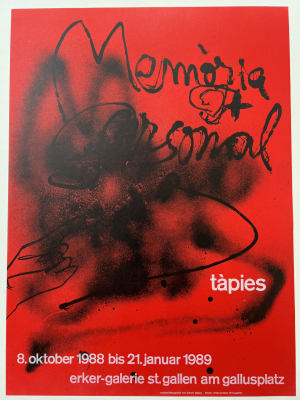
At Le Coin des Arts you will currently find two original Tàpies lithographs, selected for print quality, edition, provenance and condition. The first is Lithographie en noir, terre de Sienne et rouge (1963), hand-signed in pencil and numbered from an edition of 150, printed at the Erker-Presse in St. Gallen, Switzerland, and listed as Galfetti no. 47. The second comes from the 1973 Hommage à Picasso portfolio published in Berlin by Propyläen-Verlag – the same portfolio represented in the collection of the Museum of Modern Art. We also have the 1988 Memòria Personal poster, which is a poster, not an original print.
Tàpies came to art almost by accident. A serious lung illness kept him in bed from 1940 to 1942, and he spent the time drawing and painting. He then studied law (1943–1946) before dropping out to paint full time, with only a brief stint at the Nolasc Valls drawing academy. Self-taught, he was already experimenting with collage, scratching and materials such as string, rice, earth and wire. In 1948 he co-founded the magazine Dau al Set in Barcelona with poet Joan Brossa, painters Joan Ponç and Modest Cuixart, philosopher Arnau Puig and Joan-Josep Tharrats. In the late 1940s he also made his first etchings, at the workshop of Enric Tormo.
After his first solo show at Barcelona’s Galeries Laietanes in 1950 and a stay in Paris on a French government scholarship, Tàpies broke through in 1953: he won a prize at the second São Paulo Bienal and had his first two solo shows in the United States, at Marshall Field & Company in Chicago and at the Martha Jackson Gallery in New York. Martha Jackson and Gordon B. Washburn became key supporters, helping him move to larger formats. Jackson showed him regularly into the 1970s. In 1958 he took first prize at the Carnegie Institute in Pittsburgh. In 1959 he was included in the inaugural exhibition of Frank Lloyd Wright’s new Solomon R. Guggenheim Museum, and in 1960 he showed again at the Guggenheim and at the Museum of Modern Art, in New Spanish Painting and Sculpture. The Guggenheim gave him a retrospective in 1962.
Back in Europe, his matter paintings were first shown in Paris in 1955, where he met critic Michel Tapié. He took part in the Venice Biennale in 1954 and 1958 (UNESCO Prize) and in documenta II in Kassel in 1959. Retrospectives in Hanover and Zurich followed in 1962. In 1963 he moved into a Barcelona studio-house by architect José Antonio Coderch. A committed opponent of Franco, he was arrested and fined after joining the 1966 Caputxinada, a clandestine student assembly at the Capuchin convent in Sarrià. He published La pràctica de l’art in 1970, and his memoir Memòria personal eleven years after he began it in 1966. In Paris, he began a long working relationship with the Galerie Maeght.
American museums kept returning to his work. The Albright-Knox Art Gallery in Buffalo organized a touring exhibition in 1977, and MoMA presented him in 1992. That same year he was elected an honorary member of the American Academy of Arts and Sciences. The Guggenheim showed him again in 1995, and in New York he was represented in later decades by Pace (PaceWildenstein), with shows in 2000, 2003 and 2010; Dia:Beacon exhibited his work in 2009. In Spain, he founded the Fundació Antoni Tàpies in 1984; it opened to the public in Barcelona in 1990, the year of his Reina Sofía retrospective in Madrid. In 1993 his installation Rinzen earned the Golden Lion in Venice. He was made a Marquis by King Juan Carlos I in 2010 and died in Barcelona in 2012, at age 88. Today his work is in major American collections, including the Museum of Modern Art.
Tàpies made his first prints in 1947, but printmaking only became a regular part of his practice in the late 1950s, driven by his publishers. The key names are Sala Gaspar and Ediciones Polígrafa in Barcelona, Erker in St. Gallen, Maeght and later Lelong in Paris, and Galeria Toni Tàpies. He worked in lithography, etching and aquatint, screenprinting, monotype and collage, and liked to say he used a copper plate the way he would use a piece of cardboard or paper. Embossing and relief are hallmarks. The Hommage à Picasso lithograph is a good example of a collaborative project: according to MoMA, the portfolio was printed by Imprimerie Arte in Paris and gathered sixty-nine prints by different artists – thirty-one lithographs, twenty-two screenprints, eleven etchings, three aquatints and two woodcuts. His artist’s books include collaborations with Joan Brossa, Octavio Paz, Rafael Alberti and José Saramago.
The go-to reference is Mariuccia Galfetti’s catalog raisonné of the prints: Tàpies. Obra gráfica 1947–1972 (Gustavo Gili, Barcelona, 1973), followed by Obra gráfica 1973–1978 (Gustavo Gili, 1980) and Obra gráfica 1979–1986, co-authored with Núria Homs. A reference such as “Galfetti 47” is simply the entry number in this sequence.
Edition size. Most editions run from a few dozen up to about 150 impressions, sometimes with an extra Roman-numeral series. MoMA records the Hommage à Picasso portfolio in 90 Arabic- and 30 Roman-numbered copies. Compare the edition with the catalog.
Signature. Look for a pencil signature and a handwritten number. A signature printed in the plate does not make a sheet hand-signed. More on signatures.
Paper and margins. Check embossing under raking light and make sure the margins are intact.
Catalog raisonné. Ask for the Galfetti number; for post-1986 work, the printer and publisher identify the sheet.
Condition. Watch for light-staining, creases, foxing and old tape. Matte blacks and earth tones show restoration easily.
Provenance. Sheets from portfolios or books are fine – as long as the seller says so.
Red flags. Exhibition posters and offset reproductions are not original prints; unsigned plates from Derrière le miroir are a separate, more affordable category. Read our pages on authenticity and framing.
Le Coin des Arts chooses its Antoni Tàpies prints one by one. Explore related artists: Joan Miró, Eduardo Chillida, Pablo Picasso, Adolph Gottlieb and Sam Francis, plus our contemporary art and lithographs and etchings sections.
Mariuccia Galfetti, Tàpies. Obra gráfica 1947–1972, Gustavo Gili, 1973 · Mariuccia Galfetti, Tàpies. Obra gráfica 1973–1978, Gustavo Gili, 1980 · Mariuccia Galfetti and Núria Homs, Tàpies. Obra gráfica 1979–1986, Gustavo Gili · MoMA – Antoni Tàpies · MoMA – Hommage à Picasso portfolio · Fundació Antoni Tàpies – Biography · Waddington Custot – Exhibition history · MACBA – Antoni Tàpies

Secure payment
3DSecure 2.2

Free DHL Express delivery from €1,200
Carefully prepared parcel
Parcel tracking

Shipment insured
for the full value of the artwork, covering theft and damage

Fairest prices
Certificate of authenticity
Two galleries in Paris
Receive an email as soon as a new artwork is added for this artist
Your message has been sent ! We will get back to you as soon as possible.
Please fill in the form if you need further information such
Please fill in your email address, an email will be sent with a link to update your password.
You can now place orders and track your orders.
To save your wishlist, you can log in or create an account :
This is a 100% custom-made frame, carefully crafted by a professional framer. Finishes are available in light oak, white wood or black wood, with or without mat board and plexiglass. Delivery times may vary depending on the order, with an average lead time of 10 days.
This option will be offered during the cart step.


