
(1907-1975)

WOTRUBA Fritz
Hommage à Hans Arp, 1967
Lithograph LCD7265
350.00€


WOTRUBA Fritz
Hommage à Hans Arp, 1966
Lithograph LCD4684
350.00€

WOTRUBA Fritz
Il pleuvait, 1978
Lithograph LCD3817
350.00€

WOTRUBA Fritz
Erker-Treffen 2, 1974
Lithograph LCD4754
Sold

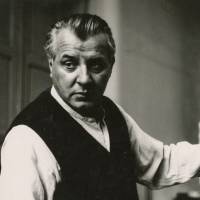
© Belvedere, Vienna, donation from the estate of Franz Hagenauer Photo: Belvedere, Vienna, Estate Fritz Wotruba
Fritz Wotruba was born in Vienna on April 23, 1907, and died there on August 28, 1975. He is widely recognized as one of the most influential Austrian sculptors of the 20th century. His figures look built rather than modeled: blocks, cylinders, and slabs stacked into standing, seated, or reclining bodies, first carved in stone and later cast in bronze. The Museum of Modern Art in New York owns his work and included him in its 1959 survey New Images of Man. Wotruba was also a committed draftsman and printmaker, and his original lithographs offer collectors an accessible way into one of the defining sculptors of postwar Europe.
At Le Coin des Arts, you’ll find Fritz Wotruba fine art prints from two celebrated portfolios. Two lithographs come from Hommage à Hans Arp, a set of small prints (about 8 3/4 × 6 3/4 in.) assembled after Arp’s death in 1966; one is signed in pencil and numbered in Roman numerals XVIII/XX. The third, Il pleuvait, accompanies a poem in Jean Cassou’s portfolio Vingt-deux poèmes, published in 1978, after the artist’s death (copy numbered 29/115). We chose each sheet for print quality, edition, provenance, and condition.
Wotruba was the youngest of eight children; his father, from Bohemia, was a tailor’s assistant and his mother, from Hungary, a housemaid. From 1921 to 1925 he trained as a die engraver, cutting metal stamps, before enrolling in 1926 at Vienna’s School of Applied Arts to study sculpture with Anton Hanak and Eugen Steinhof. He was expelled in 1929 for disciplinary reasons. That same year he married Marianne Fleck (1905-1951) of Düsseldorf. His career took off fast: a first solo show at the Museum Folkwang in Essen, Germany, in 1931, followed by appearances at the Venice Biennale in 1932, 1934, and 1936.
Politics shaped the next decade. In March 1933, after Austria’s parliament was shut down, Wotruba spent eight months in Zurich. Back in Vienna, he befriended the future Nobel laureate Elias Canetti, who would write warmly about his sculpture in 1954. After Nazi Germany annexed Austria, he fled to Switzerland in September 1938; his wife followed in January 1939, and in May 1939 they moved to Zug. Their house became a gathering place for Swiss and émigré artists and writers, including Robert and Martha Musil, while Swiss collectors such as Fritz and Editha Kamm, Georg Reinhart, and Emil Bührle supported his work. During these years of exile, Wotruba arrived at his own sculptural language.
In December 1945, Wotruba came home to lead a master class in sculpture at the Academy of Fine Arts Vienna; he was named professor in 1947 and full professor in 1954. His students included Joannis Avramidis, Alfred Hrdlicka, Josef Pillhofer, and Roland Goeschl. His monumental stone figures of the late 1940s, among them the Large Seated Figure nicknamed the “Human Cathedral” (1949), entered the Austrian national collection, today’s Belvedere, in 1954. From 1953 into the mid-1960s, he also ran the program of Vienna’s Galerie Würthle. His Large Figure Relief for the Austrian pavilion at the 1958 Brussels World’s Fair earned the fair’s grand prize for sculpture.
Wotruba’s reputation in the United States grew through the 1950s and 1960s. Of his more than seventy solo exhibitions, nearly fifty took place outside Austria. Beyond New Images of Man at MoMA in 1959, he had a solo presentation at the Institute of Contemporary Art in Boston, his work toured the country, and he appeared at the world’s fairs in Seattle and Montreal. He exhibited alongside Louise Nevelson and Isamu Noguchi. American museums also hold his prints: the Museum of Fine Arts, Houston, owns his lithograph from Hommage à Hans Arp together with other sheets from the portfolio, among them Robert Motherwell’s To Arp (1966), a gift of Alvin S. Romansky.
Wotruba took part in documenta II (1959) and documenta III (1964) in Kassel and, in all, seven Venice Biennales. In 1963, Vienna’s Museum of the 20th Century gave him his first comprehensive exhibition in his hometown. With director Gustav Rudolf Sellner, he designed sets and costumes for Sophocles and Wagner’s Ring (1959-1967). His final major project, the Church of the Most Holy Trinity in Vienna-Mauer, grew out of a 1967 model and was built from 1974 to 1976 with architect Fritz Gerhard Mayr. Wotruba, who married Lucy Vorel in 1955, died before its completion. His estate, managed by the Fritz Wotruba Foundation from 2007, has belonged to the Belvedere since 2021 and is housed in the Wotruba Depot and Study Room at Belvedere 21, which staged the retrospective “Wotruba International” from July 17, 2025, to January 11, 2026.
Wotruba’s printmaking took off around 1950. In lithography, he reduced a figure to a few heavy, outlined volumes stacked in balance, a direct echo of his carved stone. Many of his prints were issued in collective portfolios. Hommage à Hans Arp gathers lithographs by Motherwell, Asger Jorn, Antoni Tàpies, Hans Hartung, Alberto Magnelli, Ossip Zadkine, Bernhard Heiliger, and others. Jean Cassou’s Vingt-deux poèmes pairs each poem with a print by a different artist, including Alexander Calder, Marc Chagall, Joan Miró, Mark Tobey, and Serge Poliakoff.
The key reference is Renata Antoniou’s Fritz Wotruba. Druckgraphik 1950-1975, published by the Albertina in Vienna for its 1989 exhibition; a 2003 study by the same author is also cited in the Neue Deutsche Biographie. Sculpture is catalogued by Otto Breicha and Nicole Pfister (Erker-Verlag, St. Gallen, 2002).
Look for the pencil signature. A hand-signed impression commands a clear premium over an unsigned sheet from the same portfolio. Learn more about the signature.
Watch the dates. Wotruba died in 1975. A later date, like 1978 for the Cassou portfolio, is the publication date, not the date he made the image. Ask how and when the sheet was signed.
Check the edition. The Houston impressions of Hommage à Hans Arp are numbered out of 100, with additional copies in Roman numerals. See the printing process.
Identify the portfolio. Many sheets now sell loose. Confirm the portfolio title, the sheet size, and if possible the original text page or colophon.
Ask for the catalog number. Ask whether the print is recorded in Antoniou; if not, documented provenance matters even more.
Inspect condition. Look for light stain, foxing, and old tape. Posters and reproductions are not original prints. Read our pages on authenticity and framing.
We present Wotruba’s lithographs alongside works by the sculptors and artists in his orbit: Hans Arp, Alexander Calder, Henry Moore, Marino Marini, and Bernhard Heiliger. Browse modern art and our engravings and lithographs.
Renata Antoniou, Fritz Wotruba. Druckgraphik 1950-1975, Graphische Sammlung Albertina, Vienna, 1989 · Otto Breicha and Nicole Pfister, Fritz Wotruba. Werkverzeichnis, ed. Jürg Janett, Erker-Verlag, St. Gallen, 2002 · Gabriele Stöger-Spevak, “Wotruba, Fritz,” Neue Deutsche Biographie, vol. 28, 2024 · MFAH Houston – Hommage à Hans Arp · Belvedere – Wotruba International · Belvedere – Wotruba Depot · Deutsche Biographie – Fritz Wotruba

Secure payment
3DSecure 2.2

Free DHL Express delivery from €1,200
Carefully prepared parcel
Parcel tracking

Shipment insured
for the full value of the artwork, covering theft and damage

Fairest prices
Certificate of authenticity
Two galleries in Paris
Receive an email as soon as a new artwork is added for this artist
Your message has been sent ! We will get back to you as soon as possible.
Please fill in the form if you need further information such
Please fill in your email address, an email will be sent with a link to update your password.
You can now place orders and track your orders.
To save your wishlist, you can log in or create an account :
This is a 100% custom-made frame, carefully crafted by a professional framer. Finishes are available in light oak, white wood or black wood, with or without mat board and plexiglass. Delivery times may vary depending on the order, with an average lead time of 10 days.
This option will be offered during the cart step.