
(1890-1967)
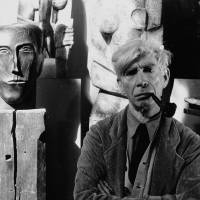
Emmy Andriesse for Anefo, Public domain, via Wikimedia Commons
Sculptor, draftsman and printmaker, Ossip Zadkine (1888-1967) spent the darkest years of World War II in New York, teaching at the Art Students League and exhibiting alongside Léger and Chagall in the landmark Artists in Exile show. Back in Europe, he created one of the most powerful war memorials of the 20th century, The Destroyed City in Rotterdam, and won the top sculpture prize at the 1950 Venice Biennale. A leading figure of modern art and the School of Paris, he is represented in American collections such as the Museum of Modern Art, the National Gallery of Art in Washington and LACMA. His etchings and lithographs offer collectors a direct way into his world.
Galerie Le Coin des Arts in Paris regularly sources original Zadkine artwork on paper – hand-signed etchings, lithographs and illustrated books – selected for print quality, provenance and condition. The gallery ships worldwide by insured DHL Express, free of charge for orders from €1,200.
Zadkine was born Yossel Aronovich Tsadkin in Vitebsk, in the Russian Empire (today Belarus). Archival research points to 1888, though the artist always gave his birth year as 1890. Raised mainly in Smolensk, he attended Yehuda Pen’s art school in Vitebsk – the same school as Marc Chagall. Around 1905 he was sent to relatives in Sunderland, England, where he learned woodcarving, then moved on to London, taking evening classes at the Regent Street Polytechnic and studying ancient sculpture at the British Museum.
He arrived in Paris in the fall of 1910, left the École des Beaux-Arts after six months and, from 1911, worked at the artists’ colony of La Ruche, practicing direct carving in wood and stone. In Montparnasse he got to know Picasso, Matisse, Apollinaire and Modigliani. Volunteering for the French army on January 24, 1916, he served as a stretcher-bearer with a Russian ambulance unit, was gassed late that year and discharged in October 1917. His front-line drawings led to his first prints: a portfolio of twenty war etchings. He married the painter Valentine Prax in August 1920 and became a French citizen in 1921, while his sculpture reached its most Cubist phase.
In 1928 Zadkine moved into the house and studio at 100 bis rue d’Assas, now the Musée Zadkine, a museum of the City of Paris. Increasingly drawn to Greek mythology, he modeled figures for bronze such as Orpheus and Diana. Solo exhibitions followed in London, at the Venice Biennale (1932) and in New York in 1933. In 1934 he bought a country house at Les Arques, in southwest France.
On June 20, 1941, Zadkine sailed from Lisbon to New York. He rented a studio in Greenwich Village and, though anxious for news of his wife in occupied France, kept working. Wildenstein showed his gouaches in October 1941; in March 1942 the Pierre Matisse Gallery included him in Artists in Exile with Fernand Léger, Chagall, Lipchitz and André Masson; and in 1943 the Valentine Gallery staged a solo exhibition of his sculpture. He taught at the Art Students League and produced The Prisoner (1943) and Phoenix (1944) before sailing home in September 1945.
Commissioned by Rotterdam in 1950 and dedicated in 1953, The Destroyed City – a bronze figure about six meters tall with a hole torn through its body – became a symbol of civilian suffering in war. Zadkine won the Grand Prize for Sculpture at the 1950 Venice Biennale, taught at the Académie de la Grande Chaumière in Paris until 1958, and received retrospectives in Cologne (1960), London’s Tate Gallery (1961) and Zurich (1965). He died in Paris on November 25, 1967.
Zadkine made prints for nearly fifty years. His etchings keep the nervous energy of his drawings, while his lithographs, often in color, translate his sculpted musicians, couples and mythological heroes into flowing outlines. Key artist’s books include Les Travaux d’Hercule (1960), Claude Aveline’s Portrait de l’Oiseau-Qui-N’Existe-Pas (Geneva, 1965, 18 lithographs), Robert Ganzo’s Lespugue (1966) and Apollinaire’s Sept Calligrammes (1967, 10 etchings). The prints are documented in the catalogue raisonné by Christophe Czwiklitzer, Ossip Zadkine, le sculpteur-graveur de 1919 à 1967 (1967) – cited as “Czwiklitzer #” – and the sculpture in Sylvain Lecombre’s Ossip Zadkine. L’œuvre sculpté (1994).
When evaluating a Zadkine etching or lithograph, review: the technique; the edition size and numbering (or artist’s proof designation); the hand signature in pencil; the Czwiklitzer catalogue number; publisher and printer; whether the sheet comes from a limited edition book; and provenance and condition, including margins, toning and foxing.
Original print or reproduction? Exhibition posters and reproductions of Zadkine’s gouaches are common on the market. A true original print is created by the artist for the printing process, issued in a limited edition and listed in the catalogue raisonné; a poster has text and no numbering. Plates from illustrated books are original prints but are generally not individually signed.
Galerie Le Coin des Arts vets every Zadkine artwork for authenticity, provenance and condition, and offers advice on museum-quality framing. Explore related artists: Marc Chagall, Fernand Léger, André Masson and Pablo Picasso.
Musée Zadkine biography, Paris Musées · Ossip Zadkine, Wikipedia · Sculptures by Zadkine, Valentine Gallery, New York, 1943 (Van Abbemuseum library) · Sylvain Lecombre, Ossip Zadkine. L’œuvre sculpté, Paris, 1994 · Christophe Czwiklitzer, Ossip Zadkine, le sculpteur-graveur de 1919 à 1967, Paris, 1967

Secure payment
3DSecure 2.2

Free DHL Express delivery from €1,200
Carefully prepared parcel
Parcel tracking

Shipment insured
for the full value of the artwork, covering theft and damage

Fairest prices
Certificate of authenticity
Two galleries in Paris
Receive an email as soon as a new artwork is added for this artist
Your message has been sent ! We will get back to you as soon as possible.
Please fill in the form if you need further information such
Please fill in your email address, an email will be sent with a link to update your password.
You can now place orders and track your orders.
To save your wishlist, you can log in or create an account :
This is a 100% custom-made frame, carefully crafted by a professional framer. Finishes are available in light oak, white wood or black wood, with or without mat board and plexiglass. Delivery times may vary depending on the order, with an average lead time of 10 days.
This option will be offered during the cart step.