
(1901-1980)


MARINI Marino
Horses and Riders V, 1972
Lithograph LCD6588
2 400.00€


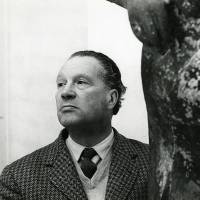
Portrait de Marino Marini par Paolo Monti, 1958 - Fondo Paolo Monti, Civico Archivio Fotogragico of MilanCC BY-SA 4.0
Marino Marini was born on February 27, 1901, in Pistoia, Italy, and died on August 6, 1980, in Viareggio. He is best known for his Horse and Rider sculptures, an image he returned to for half a century, and he won the Grand Prize for Sculpture at the 1952 Venice Biennale. American collectors and museums were among his earliest supporters: the Museum of Modern Art showed and bought his work from 1949, and New York dealers Curt Valentin and Pierre Matisse represented him. Marini was also a prolific printmaker, and his original lithographs and color etchings remain the most accessible way to collect his work.
Right now, Le Coin des Arts has two Marino Marini prints available: Chevaux et cavaliers V (1972), a color lithograph from the Chevaux et cavaliers series printed by Mourlot in Paris, and Les jongleurs (1978), a late etching and aquatint. We chose both for print quality, edition, provenance, and condition.
Marini and his twin sister, Egle, were born in Pistoia. In 1917, he entered the Florence Academy of Fine Arts, where he studied painting with Galileo Chini and later sculpture with Domenico Trentacoste. He made his first etchings there around 1920. He exhibited at the Venice Biennale for the first time in 1928, and in 1929 moved to Milan at the invitation of sculptor Arturo Martini, taking over his teaching post at the art school of the Villa Reale in Monza. He held it until 1940. Prizes followed: third prize at the first Rome Quadriennale in 1931, first prize for sculpture at the second Quadriennale in 1935, and the Grand Prix for sculpture at the 1937 Paris World’s Fair for a wooden Boxer.
In 1934, Marini saw the medieval Bamberg Rider in Bamberg Cathedral, Germany. From then on, horse and rider became his signature subject. He married Mercedes Pedrazzini, whom he nicknamed “Marina,” on December 14, 1938. In 1941 he was named professor of sculpture at Milan’s Brera Academy. When the bombing of Milan destroyed many of his works, the couple moved in December 1942 to Tenero, near Locarno, in Switzerland. There he spent time with Alberto Giacometti, Fritz Wotruba and Germaine Richier, showed in Basel, Bern and Zurich, and made his first lithographs, about forty sheets, between 1943 and 1945. He returned to Milan in the spring of 1946.
At the 1948 Venice Biennale, Marini met the New York dealer Curt Valentin, who included him in a group show at his Buchholz Gallery that September. In 1949 Marini appeared in “Twentieth-Century Italian Art” at the Museum of Modern Art, which that year acquired a Horseman in ink and gouache, following a bronze Horse and Rider. In February and March 1950, he made his first trip to the United States for his first American solo show at the Buchholz Gallery, and began his portraits of Igor Stravinsky. That year Edgar J. Kaufmann bought a version of The Angel of the City, the rider Peggy Guggenheim had cast in bronze for her Venice palazzo. After Valentin died in 1954, Pierre Matisse became Marini’s New York dealer. Today his work is in the collections of MoMA, the Hirshhorn Museum in Washington, D.C., the Norton Simon Museum and the National Gallery of Art, which holds prints such as the 1960 portfolio The Miracle (Le miracle).
Marini won the Grand Prize for Sculpture at the 1952 Venice Biennale and the Feltrinelli Prize in 1954. In the mid-1950s his riders began to rear and topple in the Miracles and Warriors; in 1958 he described his equestrian figures as symbols of the anguish he felt about contemporary events. He showed at the first three documenta exhibitions in Kassel (1955, 1959 and 1964), painted portraits of Henry Moore, Jean Arp and Mies van der Rohe, and had his first Italian retrospective at the Palazzo Venezia in Rome in 1966.
In 1972, Milan made Marini an honorary citizen, and his donation created the Museo Marino Marini at the city’s modern art gallery; that year he also designed Stravinsky’s Rite of Spring at La Scala. A cast of his 1940 Pomona went on view at the Uffizi in 1974. In 1976, Munich’s Staatsgalerie Moderner Kunst gave him a permanent gallery, and in 1978 a touring show of his sculpture and painting traveled to museums in Japan, while Marini donated a bronze rider to the Musée d’Art Moderne in Paris. He died in Viareggio on August 6, 1980. The Marino Marini Foundation was set up in Pistoia in 1983, and the Museo Marino Marini opened in Florence, in the former church of San Pancrazio, on October 21, 1988.
Check the catalog raisonné. The reference is Giorgio and Guido Guastalla, Marino Marini. Catalogo ragionato dell’opera grafica (incisioni e litografie) 1919-1980 (Graphis Arte, Livorno, 1990), with an English edition in 1993 co-published by Leslie Sacks Editions in Los Angeles. Lithographs are numbered with an “L”: “Guastalla L105” means lithograph no. 105.
Look at the edition size. Editions are small. The 1972 Chevaux et cavaliers lithographs were issued in 50 numbered impressions; late etching portfolios such as Marino from Shakespeare I (1978) in 75, plus artist’s proofs and Roman-numeral impressions. Learn more about the printing process.
Find the signature. Marini signed in pencil with his first name only, “MARINO,” in capital letters, usually at lower right. A printed signature does not count. See the signature.
Inspect the condition. Late lithographs use large areas of flat color and gold, silver or black backgrounds that show every scuff. Look for full margins, no fading and no old tape, and use conservation framing.
Avoid look-alikes. Exhibition posters, reproductions and book plates are not original prints. Read our authenticity guarantees and what makes an original print.
The British Museum counts 236 etchings and aquatints, 163 lithographs and three screenprints by Marini. After early intaglio plates, he took up lithography in wartime Switzerland and went back to etching in 1946 with The Hanged Man. In the 1970s, his lithographs turned to bold flat color. The 1972 Chevaux et cavaliers series was printed by Mourlot in Paris and published by XXe Siècle, Paris, together with Leon Amiel in New York, which helps explain how many impressions reached American collections. The etching album Marino to Strawinsky (1972) was published by Albra in Turin and printed by Il Cigno in Rome. His last major color etching portfolios, Marino from Shakespeare (1977-1978), combine etching, aquatint and drypoint on Arches paper.
At Le Coin des Arts, Marini’s prints sit alongside those of artists he knew and exhibited with: Alexander Calder, Henry Moore, Jean Arp, Alberto Giacometti and Fritz Wotruba. Explore modern art and our fine art prints.
Giorgio and Guido Guastalla, Marino Marini: Catalogue Raisonné of the Graphic Works (Engravings and Lithographs) 1919-1980, Graphis Arte / Leslie Sacks Editions, 1993 · MoMA – Marino Marini · MoMA – Press release, September 1949 · National Gallery of Art – The Miracle · Fondazione Marino Marini – Biography · British Museum – Marino Marini

Secure payment
3DSecure 2.2

Free DHL Express delivery from €1,200
Carefully prepared parcel
Parcel tracking

Shipment insured
for the full value of the artwork, covering theft and damage

Fairest prices
Certificate of authenticity
Two galleries in Paris
Receive an email as soon as a new artwork is added for this artist
Your message has been sent ! We will get back to you as soon as possible.
Please fill in the form if you need further information such
Please fill in your email address, an email will be sent with a link to update your password.
You can now place orders and track your orders.
To save your wishlist, you can log in or create an account :
This is a 100% custom-made frame, carefully crafted by a professional framer. Finishes are available in light oak, white wood or black wood, with or without mat board and plexiglass. Delivery times may vary depending on the order, with an average lead time of 10 days.
This option will be offered during the cart step.