
(1887-1965)
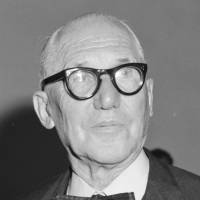
Joop van Bilsen for Anefo, CC0, via Wikimedia Commons
Everyone knows Le Corbusier the architect. Fewer people know the painter, draftsman and printmaker who worked under the same name. Born Charles-Édouard Jeanneret on October 6, 1887, in La Chaux-de-Fonds, Switzerland, he died on August 27, 1965, at Roquebrune-Cap-Martin in southern France. Between those dates he cofounded Purism, painted hundreds of canvases, designed tapestries and sculptures, and produced two major works on paper: the lithographed book Le Poème de l’angle droit (1955) and the color etching suite Unité (1963–65).
Right now, Le Coin des Arts has one Le Corbusier in stock: Marines, a unique original drawing dated 1934, made in the years when the artist summered on the French Atlantic coast and drew boats, shells and driftwood. Beyond that piece, the gallery tracks the market for his original lithographs and etchings and offers them when good impressions with solid provenance and condition come up.
His father, Georges-Édouard Jeanneret, enameled watch dials; his mother, Marie Charlotte-Amélie Perret, was a musician. From 1900 to 1904, the teenager studied engraving and chasing of watch cases at the local art school – his first experience with a burin came long before his first building. Teacher Charles L’Eplattenier pushed him toward architecture. After working on the Villa Fallet in 1906, he traveled: Tuscany and Vienna, then the Paris office of concrete specialists Auguste and Gustave Perret (1908–09), then Peter Behrens in Berlin (1910–11), then a long trip through Greece, Asia Minor and southern Italy, documented in sketchbooks and watercolors. Back in Switzerland, he taught, opened his own office in 1912 and completed the Villa Turque for industrialist Anatole Schwob in 1917.
Jeanneret moved to Paris in February 1917. Together with painter Amédée Ozenfant, he launched Purism with the 1918 manifesto Après le cubisme (“After Cubism”) and painted his first Purist oil, La Cheminée, the same year. In 1920, Jeanneret, Ozenfant and poet Paul Dermée started the magazine L’Esprit Nouveau; that is where he first signed architecture articles as “Le Corbusier.” Their Purist paintings were shown at the Galerie Druet in 1921. In 1922 he teamed up with his cousin Pierre Jeanneret, and in 1923 he published Vers une architecture.
Around 1927, his painting moved away from bottles and guitars toward pebbles, bones, roots, shells and the human figure – what he called “objects of poetic reaction.” Every summer from 1926 to 1936, he stayed at Le Piquey on the Bay of Arcachon, sketching fishing boats, cabins and beach finds that he later simplified in his Paris studio; Marines (1934) comes out of that world. On the architecture side came the Villa Savoye in Poissy (1928–31), the founding of CIAM (1928) and the Swiss Pavilion in Paris. He became a French citizen and married Yvonne Gallis in 1930, and in 1943 introduced the Modulor, a proportioning system based on the human body.
After World War II came the Unité d’Habitation in Marseille (1947–52), commissioned by the French Ministry of Reconstruction, the chapel at Ronchamp, the La Tourette monastery and, from 1950, Chandigarh in India, the most complete of his city plans. In the United States he built the Carpenter Center for the Visual Arts at Harvard University (1961–64). American honors include the Gold Medal of the American Institute of Architects and an honorary doctorate from Columbia University. The Museum of Modern Art in New York holds both Le Poème de l’angle droit, from the Louis E. Stern Collection, and the twenty sheets of Unité. In 2013 MoMA staged Le Corbusier: An Atlas of Modern Landscapes (June 15 – September 23, 2013), curated by Jean-Louis Cohen with Barry Bergdoll, which presented him as architect, interior designer, artist, city planner, writer and photographer: paintings and drawings of sites and cities hung next to early watercolors of Italy, Greece and Turkey, sketchbooks from India, travel photographs and large models. Unité itself was shown in Chicago in 1969 at International Galleries. In 2016, UNESCO added seventeen of his sites in seven countries to the World Heritage List.
Le Poème de l’angle droit was conceived between 1947 and 1953 and published in 1955 by Tériade in Paris, printed by Mourlot in an edition of 250. Every page – handwritten poem and color image – is a lithograph; MoMA lists 121 lithographs, covers included. Most single plates sold today were taken from disbound copies. Mourlot also printed Le Modulor (1956), a six-color lithograph after a collage. Starting in 1958, Zurich dealer-publisher Heidi Weber promoted his work, and in spring 1960 he introduced her to Fernand Mourlot, who printed their lithographs, including the Panurge series (1962). Unité is a suite of 20 etchings, 17 with color aquatint, made 1963–65, printed by Aldo and Piero Crommelynck and published in 1965 by Alain C. Mazo on BFK Rives paper. Auction houses usually cite Heidi Weber’s 1988 book (“Weber” plus a page number); the paintings have a catalogue raisonné by Naïma and Jean-Pierre Jornod (Skira, 2005).
Identify the series. A Poème plate, a Weber/Mourlot lithograph and an Unité etching are different objects with different price levels. Pin down the series, printer and date before anything else.
Edition size. The Poème was printed in 250 copies and its plates are generally not signed individually. Unité sheets are numbered but not all signed – an unsigned sheet isn’t automatically a red flag. More on the printing process.
Signature. Look for a pencil signature, sometimes with a dedication. Some lithographs also show an “L-C” monogram and date drawn into the image; that is part of the print, not a hand signature. See the signature.
Watch for posthumous and reproduction prints. He died in 1965, so nothing printed later can carry his own signature. Exhibition posters and offset reproductions are common and are not original prints.
Authenticating drawings. For a one-of-a-kind work like Marines, the key reference is the Fondation Le Corbusier in Paris, keeper of the artist’s archive; auction catalogs note that it confirms authenticity and issues certificates on request.
Condition and provenance. Foxing, faded color and trimmed margins cut value; a documented ownership history supports it. See our authenticity and framing pages.
Le Coin des Arts selects works by Le Corbusier together with other leaders of modern art such as Fernand Léger, Pablo Picasso, Alexander Calder, Marc Chagall and Joan Miró. Explore our engravings and lithographs and illustrated books.
Le Corbusier. Catalogue raisonné de l’œuvre peint, Naïma and Jean-Pierre Jornod, Skira, 2005 · Le Corbusier – the artist: works from the Heidi Weber collection, Edition Heidi Weber, Zurich, 1988 · MoMA – Le Corbusier: An Atlas of Modern Landscapes · MoMA – Le Poème de l’angle droit · MoMA – Unité · Fondation Le Corbusier – Biography · Encyclopaedia Britannica

Secure payment
3DSecure 2.2

Free DHL Express delivery from €1,200
Carefully prepared parcel
Parcel tracking

Shipment insured
for the full value of the artwork, covering theft and damage

Fairest prices
Certificate of authenticity
Two galleries in Paris
Receive an email as soon as a new artwork is added for this artist
Your message has been sent ! We will get back to you as soon as possible.
Please fill in the form if you need further information such
Please fill in your email address, an email will be sent with a link to update your password.
You can now place orders and track your orders.
To save your wishlist, you can log in or create an account :
This is a 100% custom-made frame, carefully crafted by a professional framer. Finishes are available in light oak, white wood or black wood, with or without mat board and plexiglass. Delivery times may vary depending on the order, with an average lead time of 10 days.
This option will be offered during the cart step.


