
(1907-1975)

WOTRUBA Fritz
Hommage à Hans Arp, 1967
Lithograph LCD7265
350.00€


WOTRUBA Fritz
Hommage à Hans Arp, 1966
Lithograph LCD4684
350.00€

WOTRUBA Fritz
Il pleuvait, 1978
Lithograph LCD3817
350.00€

WOTRUBA Fritz
Erker-Treffen 2, 1974
Lithograph LCD4754
Sold

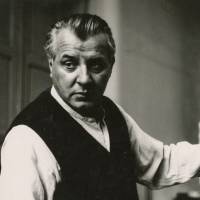
© Belvedere, Vienna, donation from the estate of Franz Hagenauer Photo: Belvedere, Vienna, Estate Fritz Wotruba
Fritz Wotruba (born in Vienna on 23 April 1907, died there on 28 August 1975) was an Austrian sculptor and one of the most influential figures in post-war European sculpture. His human figures, assembled from blocks, drums and slabs like small buildings, were first carved in stone and later cast in bronze; the Belvedere names Henry Moore, Marino Marini and Germaine Richier among his friends. For some thirty years he taught sculpture at the Vienna Academy of Fine Arts, and his last great project was a church. Alongside the sculpture he produced a substantial body of drawings and original lithographs, in which the stacked masses of his figures are pared down to a few outlined forms.
Le Coin des Arts currently offers several original lithographs by Fritz Wotruba from collective portfolios: two sheets from the Hommage à Hans Arp, a set of small lithographs (about 22 × 17 cm) gathered after Arp’s death in 1966, one of them signed in pencil and numbered in Roman numerals XVIII/XX; and Il pleuvait, the lithograph paired with a poem in Jean Cassou’s portfolio Vingt-deux poèmes, published in 1978, three years after the artist’s death (copy numbered 29/115). Each sheet has been chosen for the quality of the impression, the edition, its provenance and condition.
The youngest of eight children of a tailor’s assistant from Bohemia and a Hungarian housemaid, Wotruba first trained, from 1921 to 1925, as a die engraver, a metalworking craft that gave him an exacting hand. In 1926 he entered the Kunstgewerbeschule in Vienna, studying sculpture under Anton Hanak and Eugen Steinhof, until he was dismissed in 1929 on disciplinary grounds. That year he married Marianne Fleck (1905-1951), from Düsseldorf. Recognition came early: his first solo exhibition was held at the Museum Folkwang, Essen, in 1931, and he showed at the Venice Biennale in 1932, 1934 and 1936. In 1932 he made the memorial Mensch, verdamme den Krieg (‘Man, condemn war’) for Leoben, in Styria.
In March 1933, after the Austrian parliament was suspended, he spent about eight months in Zürich, where he carved the Large Reclining Youth. Back in Vienna he befriended the writer Elias Canetti, who in 1954 published a glowing essay on his work. After the Anschluss he fled to Switzerland in September 1938; his wife joined him in January 1939, and in May 1939 they settled in Zug. Their home became a meeting place for Swiss and émigré artists and writers, among them Robert and Martha Musil, and he was supported by collectors such as Fritz and Editha Kamm, Georg Reinhart and Emil Bührle. It was in exile that his own sculptural language took shape, while several works left in Vienna were lost or destroyed during the war.
In December 1945 Wotruba returned to Vienna to run a master class in sculpture at the Academy of Fine Arts, where he became professor in 1947 and full professor in 1954. His pupils included Joannis Avramidis, Alfred Hrdlicka, Josef Pillhofer and Roland Goeschl. The great stone figures of the late 1940s followed, notably the Large Seated Figure known as the ‘Human Cathedral’ (1949), bought by the Österreichische Galerie, today’s Belvedere, in 1954. From 1953 until the mid-1960s he was also artistic director of the Galerie Würthle in Vienna. He received the Austrian State Prize in 1955, and his Large Figure Relief for Karl Schwanzer’s Austrian pavilion at the 1958 Brussels World’s Fair won the fair’s grand prix for sculpture.
Wotruba’s British reception was closely tied to the open-air sculpture exhibitions regularly staged in London, in which his work featured, and to the generation of British sculptors with whom he shared exhibition walls: Barbara Hepworth, Lynn Chadwick, Kenneth Armitage and Eduardo Paolozzi. Tate holds his Standing Figure of 1949-50. Elsewhere he took part in documenta II (1959) and documenta III (1964) in Kassel, appeared seven times in all at the Venice Biennale, and exhibited at the Musée national d’art moderne in Paris, the Stedelijk in Amsterdam and Museum Boijmans Van Beuningen in Rotterdam. He designed sets and costumes for Sophocles and Wagner’s Ring with the director Gustav Rudolf Sellner (1959-1967). From a model of 1967 came the Church of the Most Holy Trinity at Mauer, on the edge of Vienna, built from 1974 to 1976 with the architect Fritz Gerhard Mayr. Wotruba, who had married Lucy Vorel in 1955, died on 28 August 1975 before it was finished and is buried in the Vienna Central Cemetery.
Drawing was constant in Wotruba’s practice, and his printed work grew mainly from 1950. Lithography suited him: on the stone he could restate a figure as a few heavy, contoured volumes balanced one upon another. Much of his printmaking appeared in collective portfolios and fine-press editions. The Hommage à Hans Arp brings together small lithographs by Robert Motherwell, Asger Jorn, Antoni Tàpies, Hans Hartung, Alberto Magnelli, Ossip Zadkine and Bernhard Heiliger, among others; Jean Cassou’s Vingt-deux poèmes pairs each poem with a print by a different artist, from Chagall and Miró to Serge Poliakoff and Vieira da Silva.
The standard reference for the prints is Renata Antoniou, Fritz Wotruba. Druckgraphik 1950-1975, published by the Graphische Sammlung Albertina in Vienna for its 1989 exhibition; the Neue Deutsche Biographie also cites a 2003 study of the printed oeuvre by the same author. For the sculpture, the catalogue raisonné by Otto Breicha and Nicole Pfister was issued by the Erker-Verlag of St Gallen in 2002. A sheet listed by Antoniou is normally referred to by her name followed by its number.
Signature. A sheet signed in pencil by Wotruba is worth considerably more than an unsigned impression from the same portfolio. See the signature.
Edition. Portfolio editions are small: the impressions of Hommage à Hans Arp at the Museum of Fine Arts, Houston, are numbered out of 100, and further copies exist in Roman numerals. See the printing.
Posthumous publication dates. Wotruba died in 1975, so a later date, such as 1978 for the Cassou portfolio, refers to publication rather than creation. Ask how and when the sheet was signed, and read the justification carefully.
Portfolio sheets. Many lithographs now circulate loose. Check the portfolio title and format and, where possible, whether the accompanying text or colophon survives.
Catalogue raisonné and provenance. Ask whether the sheet is recorded by Antoniou; failing that, documented provenance carries the weight.
Condition. Check for light-staining, foxing and old hinges; exhibition posters and reproductions are not original prints. See authenticity and framing.
The gallery presents Wotruba’s lithographs alongside those of the sculptors and artists around him: Henry Moore, Hans Arp, Marino Marini, Bernhard Heiliger and Ossip Zadkine. Explore modern art and our engravings and lithographs.
Renata Antoniou, Fritz Wotruba. Druckgraphik 1950-1975, Graphische Sammlung Albertina, Vienna, 1989 · Otto Breicha and Nicole Pfister, Fritz Wotruba. Werkverzeichnis, ed. Jürg Janett, Erker-Verlag, St Gallen, 2002 · Gabriele Stöger-Spevak, ‘Wotruba, Fritz’, Neue Deutsche Biographie, vol. 28, 2024 · Tate – Fritz Wotruba · Belvedere – Wotruba International · Belvedere – Wotruba Depot and Study Room · Deutsche Biographie – Fritz Wotruba

Secure payment
3DSecure 2.2

Free DHL Express delivery from €1,200
Carefully prepared parcel
Parcel tracking

Shipment insured
for the value of the artwork, covering theft and damages

Fairest prices
Certificate of authenticity
Two galleries in Paris
Receive an email as soon as a new artwork is added for this artist
Your message has been sent ! We will get back to you as soon as possible.
Please fill in the form if you need further information such
Please fill in your email address, an email will be sent with a link to update your password.
You can now place orders and track your orders.
To save your wishlist, you can log in or create an account :
This is a 100% custom-made frame, carefully crafted by a professional framer. Finishes are available in light oak, white wood or black wood, with or without mat board and plexiglass. Delivery times may vary depending on the order, with an average lead time of 10 days.
This option will be offered during the cart step.