(1885-1941)

Robert DELAUNAY
Fenêtre sur la ville, 1969
Sold
Looking for a similar artwork?
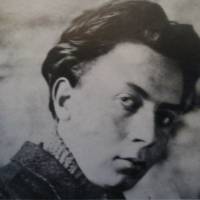
Portrait de Robert Delaunay, photographe anonyme, 1912 - Domaine public
Robert Delaunay was born in Paris on 12 April 1885 and died in Montpellier on 25 October 1941. Trained as a theatre-scenery painter, he moved through Neo-Impressionism and Cubism to become one of the first European painters to make pictures out of colour alone. His Windows and Circular Forms of 1912-1913 led Guillaume Apollinaire to coin the term Orphism, and his theory of simultaneous contrast, developed with his wife Sonia Delaunay, shaped painting, design and architecture well into the 1930s. For print collectors he presents a particular challenge: the lithographs he signed are few and date almost entirely from the 1920s, whereas prints published after his death are plentiful.
Le Coin des Arts has no work by Robert Delaunay in stock at present. We follow his market closely and offer his original lithographs when good impressions with sound provenance become available; use the “follow the artist” button to be notified.
Delaunay left school without qualifications and, around 1902, was apprenticed to a workshop of theatre decorators; by 1904 he was painting full time and showing at the Salon des Indépendants. Seurat and Van Gogh, seen at the Indépendants in 1905, and the Fauves at the Salon d’Automne, pushed him towards a mosaic-like, divided brushstroke. In 1906 he met Henri Rousseau and the painter Jean Metzinger; his Landscape with Disc of that year already announces the solar motif that would run through his work. Around 1908 he met Sonia Terk; they married in 1910, and their son Charles was born in January 1911.
From 1909 Delaunay painted the Gothic church of Saint-Séverin, its pillars seemingly bending in the light, and from 1910 the Eiffel Tower, splintered and seen from several viewpoints at once. The city series followed: a Study for ‘The City’ of 1909-10 is now at Tate, while the monumental La Ville de Paris (267 × 406 cm), painted for the Salon des Indépendants of 1912, belongs to the Centre Pompidou. The same year he exchanged letters with August Macke on colour contrast, and in Munich his paintings — La Ville no. 2, Saint-Séverin no. 1 and an Eiffel Tower — had hung in the first Blaue Reiter exhibition, in the winter of 1911-12.
The Windows series of 1912-1913 dissolves the view over Paris into overlapping transparent planes; only a sliver of green recalls the Tower. Tate owns one of the key canvases, Windows Open Simultaneously (First Part, Third Motif), 1912. Apollinaire wrote his poem Les Fenêtres for the catalogue of Delaunay’s 1913 exhibition, and named the new painting Orphism, after the musician-poet of Greek myth. The Circular Forms, Sun and Moon and the entirely non-figurative Disc followed in 1913, the same year Sonia published La Prose du Transsibérien with Blaise Cendrars. In 1914 the Homage to Blériot brought the aviator and his propeller into the whirl of colour.
War broke out while the couple were at Fuenterrabía on the Spanish Basque coast. They settled in Madrid, then lived at Vila do Conde in northern Portugal from 1915 to 1917, where Robert painted luminous market scenes and still lifes and kept up an exchange with Amadeo de Souza-Cardoso. In Madrid they began working for Diaghilev’s Ballets Russes: Robert designed the sets and Sonia the costumes for Cléopâtre, which was shown in London in 1918 — the most direct link between Delaunay and the British stage. The couple returned to Paris at the end of 1921, where Robert moved among the Dada and Surrealist poets and returned to the Tower and the city as subjects. In 1925 he decorated, with Fernand Léger, the hall of a model French embassy at the Exposition des Arts Décoratifs.
From 1930 Delaunay committed himself to abstraction again with the Rhythms series. He joined Abstraction-Création in 1931, leaving in 1934, and began making reliefs and wall coverings in new materials. Endless Rhythm (1934), from this series, is in the Tate collection. For the 1937 Paris International Exhibition he worked with the architect Félix Aublet on the decoration of the Palais de l’Air and the Palais des Chemins de Fer, including the mural Air, Iron and Water. He died of cancer in Montpellier in October 1941. Sonia, who outlived him until 1979, championed his work, and in 1964 she and Charles gave the Musée National d’Art Moderne the largest group of the couple’s works anywhere; the Centre Pompidou’s retrospective Rythmes sans fin ran from 15 October 2014 to 12 January 2015.
Delaunay came to printmaking late and made only a small group of lithographs, mostly between 1923 and 1928, revisiting his pre-war themes. The principal sheets are Saint-Séverin (a colour impression dated 1926 is in the Kunsthalle Bielefeld), La Tour (1925, titled and dated in the stone) and La Fenêtre sur la ville (1925, for which an edition of fifty was planned, though it is not known whether it was completed). In 1926 he contributed twenty black lithographs to Joseph Delteil’s Allo! Paris!, published by the Éditions des Quatre Chemins and printed by Engelmann — one of the finest illustrated books of the Art Deco years.
The standard catalogue is Jacqueline Loyer and Charles Pérussaux, ‘Robert Delaunay, catalogue de son œuvre lithographique’, Nouvelles de l’estampe, no. 15, 1974; auction houses therefore describe La Tour as ‘L. & P. 3’. For paintings and drawings, the reference is Guy Habasque’s catalogue in Du cubisme à l’art abstrait (Paris, 1957).
After 1941 a great many prints appeared ‘after’ Delaunay: unsigned plates in the review XXe Siècle (such as Air, Fer, Eau, printed by Mourlot in 1957), and lithographs published by Jacques Damase around 1969 from drawings of 1926, signed in pencil by Sonia Delaunay ‘pour Robert Delaunay’, numbered and stamped ‘Atelier Robert Delaunay’. They are honest posthumous editions, not prints signed by the artist.
Date first. Any print signed by Robert himself predates October 1941, and in practice his lithographs date from 1923-1928. Anything later is posthumous, whatever the technique.
Whose signature? Lifetime impressions are signed ‘R. Delaunay’ in pencil. A signature by Sonia, an atelier stamp or a signature in the stone points to a posthumous or unsigned edition. See our notes on the signature.
Edition and paper. Editions of the 1920s were small and are poorly documented; artist’s proofs on Japan paper exist alongside the standard edition on wove paper. Check the margins and any numbering.
Catalogue number. Ask for the Loyer and Pérussaux number. A ‘Habasque’ reference alone usually refers to the source drawing, not to the print.
Book plates. The Allo! Paris! lithographs are original but unsigned book illustrations; a loose plate is worth far less than a large signed lithograph.
Provenance and price. An artist’s proof of La Tour from the collection of the Paris dealer Henri M. Petiet was estimated at £18,000-22,000 at Sotheby’s in 2023 — fine lifetime impressions are scarce. Beware of reproductions and posters offered as originals. Our guarantees are set out on the authenticity page; for presentation, see our framing service.
The gallery selects prints by the pioneers of colour and abstraction: alongside Robert Delaunay, Sonia Delaunay, Fernand Léger, Jacques Villon, Auguste Herbin and Jean Gorin. Explore our modern art selection and our engravings and lithographs.
Robert Delaunay, Du cubisme à l’art abstrait, ed. Pierre Francastel, with a catalogue by Guy Habasque, Paris, SEVPEN, 1957 · Jacqueline Loyer and Charles Pérussaux, ‘Robert Delaunay, catalogue de son œuvre lithographique’, Nouvelles de l’estampe, no. 15, 1974 · Tate – Robert Delaunay · Tate – Windows Open Simultaneously (First Part, Third Motif) · Tate – Endless Rhythm · Centre Pompidou – Robert Delaunay, Rythmes sans fin · Sotheby’s – La Tour (L. & P. 3)

Secure payment
3DSecure 2.2

Free DHL Express delivery from €1,200
Carefully prepared parcel
Parcel tracking

Shipment insured
for the value of the artwork, covering theft and damages

Fairest prices
Certificate of authenticity
Two galleries in Paris
Receive an email as soon as a new artwork is added for this artist
Your message has been sent ! We will get back to you as soon as possible.
Please fill in the form if you need further information such
Please fill in your email address, an email will be sent with a link to update your password.
You can now place orders and track your orders.
To save your wishlist, you can log in or create an account :
This is a 100% custom-made frame, carefully crafted by a professional framer. Finishes are available in light oak, white wood or black wood, with or without mat board and plexiglass. Delivery times may vary depending on the order, with an average lead time of 10 days.
This option will be offered during the cart step.