
(1961)

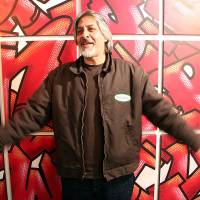
Portrait de Seen par Jean-Noël Lafargue, 2007 - CC BY-SA 3.0
SEEN – the Bronx-born writer Richard Mirando – is one of the best-known names to emerge from the New York subway graffiti of the 1970s and 1980s. Born in 1961 in the Bronx, he started painting trains in 1973 and, with his crew United Artists (UA), kept covering whole carriages in full colour until 1989. Widely called the ‘Godfather of Graffiti’ – a title his admirers bestow, though he did not found the movement – he showed in Amsterdam and in Dutch museums long before graffiti was accepted in British galleries. His later output includes canvases, drawings, sculpture, hand-painted subway maps and limited-edition screenprints.
Le Coin des Arts currently offers one screenprint by SEEN, Looney Lenny, hand-signed and numbered 35/66, with an image of 56 × 46 cm on a 65 × 55 cm sheet, in excellent condition. We follow the artist’s work and add his original prints when good impressions come our way; use the ‘follow the artist’ button to be told when they do.
An exhibition text from the Gallifet Art Center in Aix-en-Provence (2016) records that the young Mirando was already using an airbrush at eleven, painting decorations for his uncle’s car body shop and customising vehicles. In 1973 he slipped into the Lexington Avenue yard of the 6 line and painted his first piece. He chose the tag SEEN for the simplest of reasons, as Time Out London later reported: he wanted his work to be seen. The 2, 5 and 6 lines became his territory, and his rounded, outlined letters crossed the city every day, despite a running battle with the police Vandal Squad.
With United Artists – a crew whose members included his brother Mad, Pjay, Duster and Sin – SEEN made his name with whole cars painted ‘top to bottom’, from roof to floor. He is credited with dozens of them, several now regarded as defining images of the period. He went on painting trains until 1989, when many writers had already been driven off the system by the MTA’s clean-train programme. In the late 1980s he also opened a tattoo studio in New York, Tattoo Seen, which became one of the city’s most successful parlours and where he worked as a tattooist himself.
Two documents fixed SEEN’s place in the history of the movement. The film Style Wars, made by Tony Silver and Henry Chalfant and broadcast on American public television (PBS) in 1983, gave him a prominent role; the book Subway Art by Martha Cooper and Henry Chalfant (1984) reproduced his trains for a generation of readers. It was followed in 1987 by Spraycan Art, by Chalfant and James Prigoff, published in London by Thames & Hudson. Galleries followed: Yaki Kornblit in Amsterdam showed his canvases in 1982, 1983 and 1985; the Museum Boijmans Van Beuningen in Rotterdam included him in Graffiti (22 October – 4 December 1983), which then travelled to the Groninger Museum; and in spring 1984 the Galerie Thomas in Munich hung his work beside that of thirteen other New York writers. A show in Tokyo followed in 1985 – the year, according to his own website, in which he also wrote his name across the Hollywood sign.
In the 1990s SEEN was back on the gallery circuit, with a show at the Clayton Gallery in New York (1995). London soon took notice. In 2005 he exhibited at the Outside Institute, and on 26 October 2007 Sign of the Times, described at the time as his second solo show in the UK, opened at the StolenSpace Gallery in the Old Truman Brewery on Brick Lane, running until 18 November. His website also lists an Opera Gallery exhibition in London in 2014. Paris became a second base: Seen City at the Galerie Chappe (2007), a space under his own name opened in 2009, PleaSE ENjoy at the Galerie Magda Danysz (2010) and a retrospective at Opera Gallery Paris (2011). In 2015, Time Out London noted that his new work paid homage to comic-book heroes such as Wonder Woman and Spider-Man.
In 2013 Cornell University Library announced that its Hip Hop Collection had acquired the Richie ‘SEEN’ Mirando Archive: more than 149 drawings and 370 photographs, including almost all that survives of his original sketches for subway pieces, black books, gallery flyers and a rare original Style Wars poster. A year later he published They Call Me the Godfather of Graffiti, Chapter 1973–1981, a limited issue of which appeared with 100 hand-painted covers. His recent work extends to sculpture, assemblages of salvaged materials and a series of hand-painted New York subway maps; in 2018 he was part of Beyond the Streets in Los Angeles.
SEEN is a painter first – spray can, airbrush, canvas, marker and ink. His editions are mostly screenprints, signed and numbered in pencil, often in runs of only a few dozen, as with Looney Lenny in an edition of 66. Screenprinting lays down flat, opaque colour one stencil at a time, which suits his outlined lettering and saturated palette. Unlike the School of Paris masters, he never worked with the historic lithography or intaglio workshops, and his editions have been published by galleries or by the artist’s own studio. As far as we know, no catalogue raisonné of his prints has been published, so any ‘catalogue number’ quoted for a SEEN print should be treated with caution. Identification rests on the signature, the numbering, the sheet and a traceable edition. For the basics, see what is an original print.
Edition and numbering. Check that the number, the stated edition size and any date agree (see the printing). Artist’s proofs should be few in relation to the numbered edition.
Signature. His name is usually part of the image itself, as lettering. What matters is the hand-written signature in pencil, normally in the margin.
Technique. Some recent editions combine a digitally printed ground with screenprinted layers. Ask for the exact process, which affects value, and do not confuse such pieces with a purely digital print.
Signed posters. Signed posters – compilations, event posters – are offered on the market. Signed or not, they are reproductions, not original prints.
Paper, margins and condition. Large flat areas of colour show every scratch, crease or handling mark, and bright inks fade in daylight. Insist on full margins and UV-filtering glazing when framing.
Provenance. With a living, much-imitated artist, buy prints whose origin can be traced to the publishing gallery, an invoice or a certificate. Our guarantees are set out on our authenticity page.
We also select prints by other artists who came from the street: JonOne, another veteran of the New York trains, Shepard Fairey, Invader, Vhils and Cleon Peterson. Explore more contemporary art and our engravings and lithographs.
Martha Cooper and Henry Chalfant, Subway Art, 1984 · Henry Chalfant and James Prigoff, Spraycan Art, Thames & Hudson, London, 1987 · Richard ‘SEEN’ Mirando, They Call Me the Godfather of Graffiti, Chapter 1973–1981, 2014 · British Hip-Hop – Seen returns to the UK (2007) · Time Out London – SEEN (2015) · Cornell University – Hip Hop Collection acquisitions (2013) · MFA Boston – exhibition timeline · Richard Mirando – About SEEN

Secure payment
3DSecure 2.2

Free DHL Express delivery from €1,200
Carefully prepared parcel
Parcel tracking

Shipment insured
for the value of the artwork, covering theft and damages

Fairest prices
Certificate of authenticity
Two galleries in Paris
Receive an email as soon as a new artwork is added for this artist
Your message has been sent ! We will get back to you as soon as possible.
Please fill in the form if you need further information such
Please fill in your email address, an email will be sent with a link to update your password.
You can now place orders and track your orders.
To save your wishlist, you can log in or create an account :
This is a 100% custom-made frame, carefully crafted by a professional framer. Finishes are available in light oak, white wood or black wood, with or without mat board and plexiglass. Delivery times may vary depending on the order, with an average lead time of 10 days.
This option will be offered during the cart step.

