
(1863-1935)
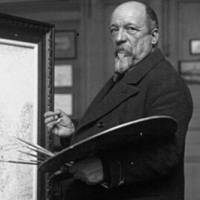
Portrait de Paul Signac par l'Agence Meurisse, 1923 - Domaine public, Bibliothèque nationale de France
Paul Signac (born in Paris on 11 November 1863, died there on 15 August 1935) was, alongside Georges Seurat, the founder of Neo-Impressionism, the method of painting in separate touches of pure colour. A co-founder of the Société des Artistes Indépendants and its president from 1908, the author of From Eugène Delacroix to Neo-Impressionism (1899), a keen yachtsman and one of the finest watercolourists of his age, he turned Saint-Tropez into a meeting point of modern painting. His printed œuvre is small, about twenty sheets recorded in the Kornfeld and Wick catalogue raisonné, yet his colour lithographs of the 1890s rank among the outstanding prints of the fin de siècle.
Le Coin des Arts follows Signac’s work closely and offers his original prints whenever fine impressions come to light, chosen for the quality of printing, condition, provenance and agreement with the catalogue raisonné. To be told when a sheet arrives, simply “follow the artist” on this page.
Signac grew up in a comfortable Parisian family that intended him for architecture. In June 1880 the first one-man exhibition of Claude Monet persuaded him to paint instead. From 1881 he taught himself, rowing on the Seine in a small boat he named Manet-Zola-Wagner. Aged seventeen, he spent the summer of 1882 at the Norman harbour of Port-en-Bessin, returning in 1883 and 1884. His education came from looking hard at the Impressionists – Monet, Degas, Caillebotte and Guillaumin – whose works he would later own.
In 1884 Signac helped found the Société des Artistes Indépendants, showed at its first Salon and met Georges Seurat. Together they developed the divided touch that the critic Félix Fénéon named “Neo-Impressionism”. Through Camille Pissarro both men took part in the eighth and last Impressionist exhibition in 1886. Signac also befriended Vincent van Gogh, painting beside him at Asnières in 1887 and visiting him at Arles in March 1889. Around 1888 he embraced anarchist ideas. His 1890 portrait of Fénéon, Opus 217, is now at the Museum of Modern Art in New York. When Seurat died in 1891, aged thirty-one, Signac became the movement’s undisputed leader.
In 1892 Signac followed Henri-Edmond Cross to the south and discovered Saint-Tropez; on 7 November that year he married Berthe Roblès, and he took up watercolour. In December 1897 he bought the villa La Hune, whose studio opened in August 1898. First serialised in 1898, D’Eugène Delacroix au néo-impressionnisme appeared as a book in 1899, making the case for pure colour and optical mixture. Its influence on the young was immediate: Henri Matisse spent the summer of 1904 at Saint-Tropez with Signac and Cross and there conceived Luxe, calme et volupté, which Signac bought after its showing at the Indépendants in 1905.
Elected president of the Indépendants in 1908, Signac held the post until his death, at the heart of the avant-garde from the Fauves onwards. A tireless sailor, he painted the ports of France, Venice, Rotterdam and Constantinople; after 1910 watercolour definitively overtook oil. He was a discerning collector too: his first purchase was a Cézanne landscape, and he owned Seurat, Pissarro, Luce and Cross, the Nabis and the Fauves, a charcoal by Odilon Redon and even a painting by the English artist Walter Sickert, as the Musée d’Orsay’s exhibition Signac collectionneur (2021-2022) revealed. The retrospective Signac 1863-1935 travelled in 2001 from the Grand Palais to the Van Gogh Museum and the Metropolitan Museum of Art.
British public collections hold a small but telling group of his works. The Courtauld in London owns Saint-Tropez (c.1893) and the late Still Life with Watermelon (1918). In Glasgow, Kelvingrove Art Gallery and Museum has the early Coal Crane, Clichy (1884) and Sunset, Herblay, Opus 206 (1889); Leeds Art Gallery has La route de Pontoise (1886), and the Fitzwilliam Museum in Cambridge two harbour subjects. Amgueddfa Cymru – Museum Wales in Cardiff received by bequest in 1954 a 1918 watercolour of Saint-Tropez, a fine example of the late wash-and-charcoal manner.
The standard reference is Eberhard W. Kornfeld and Peter A. Wick, Catalogue raisonné de l’œuvre gravé et lithographié de Paul Signac (Bern, Kornfeld und Klipstein, 1974). Prints are cited as “Kornfeld-Wick 19” or “KW 19”, with a letter or Roman numerals for the state – “19a” for a trial proof, “11, state ii/iii”. Vollard plates may also carry Una Johnson’s number (“Johnson 138”).
Signac worked chiefly in lithography. In 1889 he drew Application du cercle chromatique de Mr. Ch. Henry, a programme for the Théâtre-Libre. Saint-Tropez appeared in L’Estampe originale in 1894. In 1895 the publisher Gustave Pellet issued Les Bateaux à Flessingue (KW 12) and Les Bateaux (KW 13), both printed by Auguste Clot, the great colour printer; À Flessingue (KW 11) is a five-colour lithograph. Around 1897-98 Ambroise Vollard published Saint-Tropez: le port (KW 19), printed by Clot in an edition of 100 signed in pencil. In 1898 the Berlin review Pan carried his lithograph Abend (La jetée de Flessingue).
Check the catalogue. Every original lithograph should match a Kornfeld-Wick number, state and edition. A sheet the catalogue does not record calls for real caution.
Signature and numbering. Saint-Tropez: le port is signed in pencil “P. Signac” and numbered out of 100; Les Bateaux is found numbered out of 20, with a remarque, on China paper. A printed signature is no substitute for a hand-signed one. See the signature and the printing.
States and proofs. Several plates exist in two or three states; annotated trial proofs, such as the Saint-Tropez: le port proof in the National Gallery of Victoria, are rare documents.
Journal plates. The lithograph issued with Pan in 1898 is a genuine original print, but it was printed for a periodical: it should not be confused with, or priced like, a signed and numbered impression from a dealer’s edition.
Reproductions and posthumous issues. After his death, lithographic and stencilled reproductions “after” his watercolours and drawings were published with a printed signature and sometimes a publisher’s stamp. They are not original prints.
Condition and provenance. Clot’s colours fade in daylight: look for full margins, no light-staining or foxing, and frame behind UV-filtering glazing (see framing). Our guarantees are set out on the authenticity page.
The gallery also selects prints by other masters of colour: Henri Matisse, Odilon Redon, Edgar Degas, Robert Delaunay and Sonia Delaunay. Explore modern art and our engravings and lithographs.
Eberhard W. Kornfeld and Peter A. Wick, Catalogue raisonné de l’œuvre gravé et lithographié de Paul Signac, Kornfeld und Klipstein, Bern, 1974 · Paul Signac, D’Eugène Delacroix au néo-impressionnisme, 1899 · Signac 1863-1935, exhibition catalogue, Paris, Amsterdam and New York, 2001 · Art UK – Paul Signac in UK collections · Amgueddfa Cymru – St. Tropez (1918) · National Gallery of Victoria – Saint-Tropez: le port, trial proof · Hood Museum of Art – Les Bateaux (KW 13) · Musée des impressionnismes Giverny – Paul Signac

Secure payment
3DSecure 2.2

Free DHL Express delivery from €1,200
Carefully prepared parcel
Parcel tracking

Shipment insured
for the value of the artwork, covering theft and damages

Fairest prices
Certificate of authenticity
Two galleries in Paris
Receive an email as soon as a new artwork is added for this artist
Your message has been sent ! We will get back to you as soon as possible.
Please fill in the form if you need further information such
Please fill in your email address, an email will be sent with a link to update your password.
You can now place orders and track your orders.
To save your wishlist, you can log in or create an account :
This is a 100% custom-made frame, carefully crafted by a professional framer. Finishes are available in light oak, white wood or black wood, with or without mat board and plexiglass. Delivery times may vary depending on the order, with an average lead time of 10 days.
This option will be offered during the cart step.