Jean-Gabriel Chauvin (1889–1976), known simply as Chauvin, was one of the artists who shaped modern sculpture, alongside Brancusi and Arp. He created abstract forms that hover at the edge of figuration, in wood, stone and bronze. Celebrated for sculptures in major museum collections, he also left behind a body of charcoal drawings that is less familiar but strikingly evocative. Here is a closer look at the range and depth of his explorations of form.
Jean-Gabriel Chauvin, Sans titre 3, stone sculpture, 1945.
Chauvin is a leading figure of 20th-century art and one of the very first artists to make an abstract sculpture (La Toilette, 1909). His focus on pure form and the expressive power of volume helped lay the groundwork for modern abstract sculpture.
His sculpture spans the years 1909 to 1962 and falls into several periods, all tied together by a clean, highly personal style you can spot at a glance. Some pieces are figurative, with a symbolism that recalls ancient sculpture. Others hint at the real world, evoking the human body and anatomy. But most of his work explores a new relationship with reality—one that helped set the standards of abstract sculpture.
Over time, Chauvin’s work has come to be recognized as a major synthesis of 20th-century art, on a par with sculptors such as Brancusi, Laurens and Arp.
Jean-Gabriel Chauvin was also a photographer who shot most of his own sculptures. He favored a straight-on or three-quarter view, a plain backdrop and carefully controlled lighting. The setup is spare, almost austere. His eye is fixed on the sculpture, of course, but the photo is more than documentation—it becomes an artwork in its own right.
Jean-Gabriel Chauvin, Sans titre 2, ebony sculpture, 1929. Photo by the artist.
This signature Chauvin sculpture, featured on the cover of the 2021 exhibition L’Ombre Atomique, sums up his whole approach: the pursuit of pure form, abstract volumes and perfect symmetry. Chauvin went for the most effective view, shooting at a slight angle with carefully controlled light against a solid backdrop.
Jean-Gabriel Chauvin, Sans titre, charcoal drawing, ca. 1940.
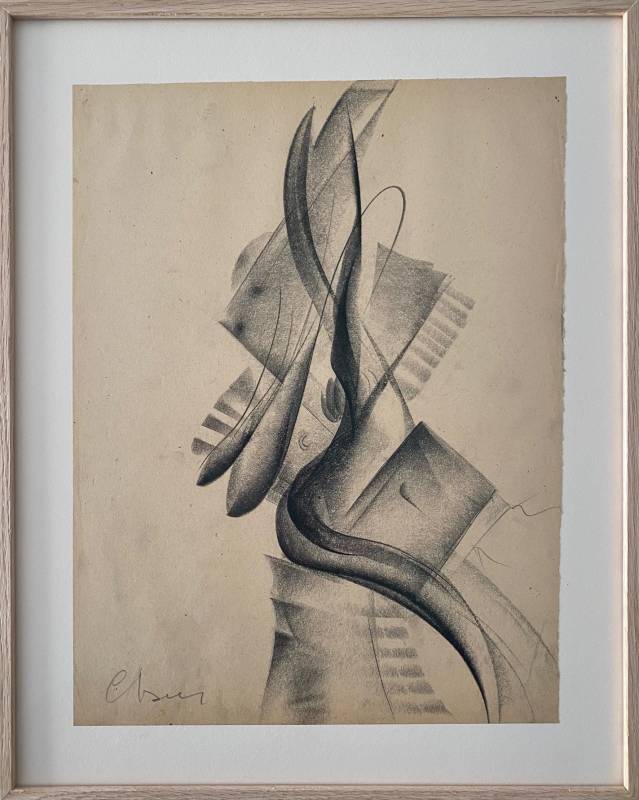
Chauvin was also a virtuoso at drawing, especially in charcoal. His compositions reveal the same move away from straightforward figuration and the same pull toward abstraction. In the drawing above, the flowing shapes are carefully constructed, yet they seem to come from a spontaneous gesture.
The composition brings to mind Boccioni’s studies of the human body in motion, broken into many facets. Every detail of the work is a small abstract composition of its own, adding up to a whole that is dynamic yet balanced.
Umberto Boccioni, Unique Forms of Continuity in Space, bronze sculpture, 1913.
But the comparison stops there: Chauvin had no known political agenda and stayed in the background of his own work, never joining any movement or artists’ group. He preferred the solitude of his studio, where he covered hundreds of sheets of paper, to the social scene of Saint-Germain-des-Prés, the hub of artistic and literary modernism in Paris.
Soft and crumbly, charcoal can produce a wide range of textures, from fine, delicate lines to broad, bold strokes. Paired with a highly expressive hand—and depending on the pressure and the smudging and rubbing techniques used—it creates beautiful shifts between light and dark.
Born in Rochefort, France, in 1889, Chauvin dedicated himself entirely to his art, and very little is known about his personal life.
His work earned recognition during his lifetime, capped by a monograph by Christian Zervos in 1960. Two years later, he represented France at the 31st Venice Biennale, alongside Serge Poliakoff. His sculpture also brought public commissions in the 1930s, including the bronze Fontaine lumineuse for the swimming pool of the ocean liner Normandie and Signal, a 36-foot concrete sculpture for the 1937 Paris World’s Fair.
Chauvin died in 1976, leaving a lasting mark on modern abstraction and an outstanding body of charcoal drawings that is still waiting to be discovered.
Jean-Gabriel Chauvin, Sans titre, charcoal, ca. 1940.
Chauvin’s drawings carry no title or date—only the artist’s handwritten signature.
Le Coin des Arts gallery has close ties to Jean-Gabriel Chauvin, as both a man and an artist. Its founder, Thaddée Poliakoff, is committed to bringing this groundbreaking, intimate yet universal body of work to a wider audience. To that end, the gallery is compiling the catalogue raisonné of the artist’s drawings.
Feel free to reach out with any additions to the catalogue or any questions.
Thaddée Poliakoff
info@lecoindesarts.com

Secure payment
3DSecure 2.2

Free DHL Express delivery from €1,200
Carefully prepared parcel
Parcel tracking

Shipment insured
for the full value of the artwork, covering theft and damage

Fairest prices
Certificate of authenticity
Two galleries in Paris
Receive an email as soon as a new artwork is added for this artist
Your message has been sent ! We will get back to you as soon as possible.
Please fill in the form if you need further information such
Please fill in your email address, an email will be sent with a link to update your password.
You can now place orders and track your orders.
To save your wishlist, you can log in or create an account :
This is a 100% custom-made frame, carefully crafted by a professional framer. Finishes are available in light oak, white wood or black wood, with or without mat board and plexiglass. Delivery times may vary depending on the order, with an average lead time of 10 days.
This option will be offered during the cart step.