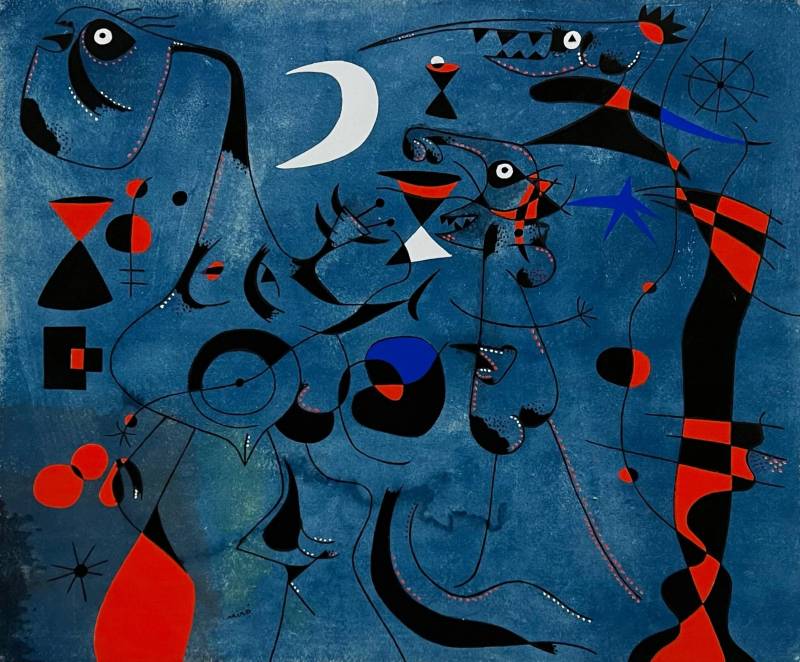
Painting the infinite in a time of war
In January 1940, working in his studio in Varengeville-sur-Mer, Joan Miró started a series of small gouaches that open onto cosmic worlds. Here he gathered and distilled the visual vocabulary he had been developing since the 1920s—stars, birds, women, crescent moons—stripped down to the essentials and scattered across a nearly empty field. When Germany invaded France in May 1940, he had to leave Normandy for Spain, where he kept working on the series and finished it in 1941.
The titles speak to the world that consumed him: the sky, birds, women, the stars. They include Le 13 l’échelle a frôlé le firmament (1940), La poétesse (1940), Le passage de l’oiseau divin (1941) and Vers l’arc-en-ciel (1941). Miró said the sight of the sky overwhelmed him, and that a crescent moon or a sun in a vast sky could shake him to the core. His paintings, he added, were really about “tiny forms in great empty spaces.”
That is what the series is truly about. These works don’t depict a scene; they place a web of signs, stars and dreamlike figures, in black and in color, in dialogue with the open space around them. They convey a yearning for freedom, poetry and escape amid the chaos of war. The background is anything but neutral—it plays a crucial role. So to translate these sheets is to capture both the signs and the space.
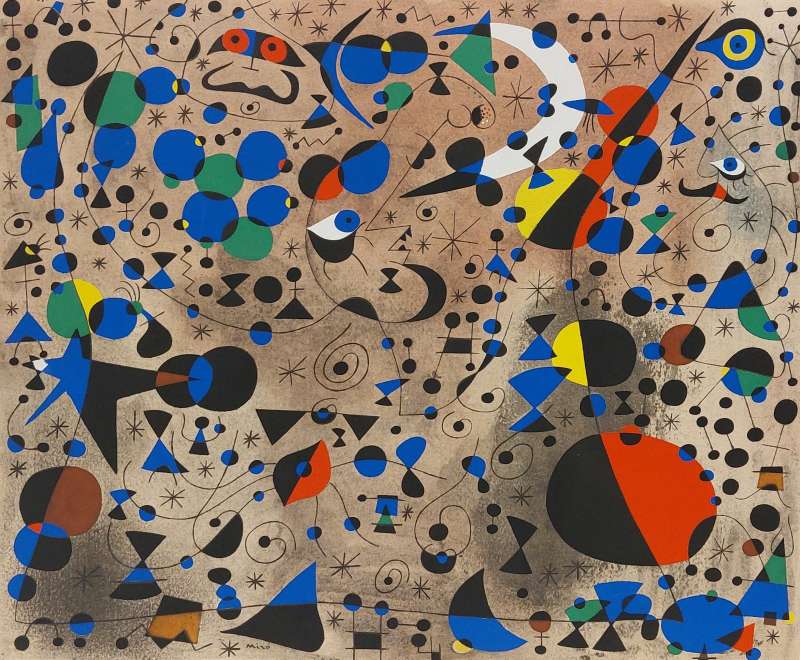
La Poétesse (Constellations), stencil print (pochoir), 1959
The Constellations come to New York
The gouaches traveled in secret, leaving Spain in a diplomatic pouch to be shown in New York at the Pierre Matisse Gallery from January 9 to February 3, 1945. The show was titled “Ceramics 1944, Tempera Paintings 1940 to 1941, Lithographs 1944.” The name Constellations appears nowhere: its origin is still unknown, and it shows up neither in the letters between Miró and Matisse nor in any of the documents published in 1945.
Twenty-two gouaches were on view; Miró chose to keep the twenty-third. The timing mattered as much as the art: these were among the first new works from Europe to reach the United States, and the show was a smash hit, especially with artists. Every gouache sold, and the series was scattered among collections.
The effect on young American artists ran deep. The Cleveland Museum of Art points out that the series’ “all-over” composition—no center, no hierarchy, nowhere for the eye to rest—had a lasting influence on the generation that followed. Painted in exile and amid shortages, these light, colorful works struck many viewers as a triumph of creative freedom over barbarism.
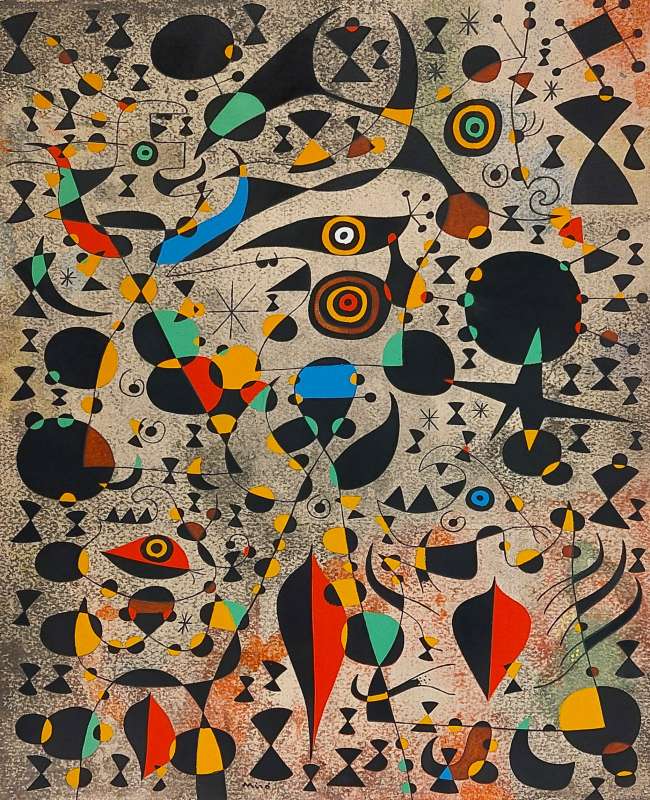
Femmes encerclées par le vol d’un oiseau (Constellations), stencil print (pochoir), 1959
From gouache to print: the 1959 edition
Nearly twenty years later, the gouaches came back in a new form. In 1959, publisher Pierre Matisse released in New York a portfolio paired with prose poems by André Breton. The Surrealist writer saw in these sheets an artist who, at a moment of extreme upheaval, had used the full range of his voice, “outside the world and, what’s more, outside time.” The same could be said of the book: a work born in the shadow of war came out in a completely different world. Each plate captures two moments—the gouache itself and its translation into print. Breton’s text adds a third, this time poetic and literary.
In the end, twenty-two stencil prints based on the gouaches, along with two etchings and two lithographs, were made in Paris print shops, including Daniel Jacomet’s studio. The twenty-third gouache—the one Miró kept—was left out.
Stencil printing (pochoir) is all about making choices. Every color needs its own hand-cut stencil, applied to the paper one after another. That means breaking the gouache down, separating its colors, setting an order, and deciding what will be kept and what has to go. The translucence of a wash, a happy accident of the brush, the shimmer of a background can’t simply be carried over—they have to be reinvented by other means. “Reproduction” doesn’t really describe this work. “Translation,” with everything it implies about faithfulness and interpretation, is a better fit.
Collotype meets stencil: the Jacomet process The Jacomet studio described its method as a pairing of two techniques that address the two sides of the work: space on one hand, signs on the other. Collotype captures the structure. A coat of light-sensitive bichromated gelatin is exposed through a photographic negative. The gelatin hardens wherever light hits it and stays swollen with moisture where the dark areas of the negative block the light. Oil-based ink then settles unevenly, reproducing every tone from black to white with no halftone screen. This is how the process records, photographically, the drawing and the texture of the background. The stencil adds the color. Each hue is brushed on through a sheet of zinc one-tenth of a millimeter thick, cut with a blade to match the shapes to be colored. A single plate can require fifteen to forty stencils—sometimes sixty. The studio charts the range of tones for each color, starting with the lightest, and plans how the layers will interact. Sometimes the color is softened and blended with a smaller brush. For every original—gouache, watercolor or pastel—the studio weighs what photography can capture and what only the hand can redo. That judgment call is already a form of translation. Happy with the results, Miró teamed up with Jacomet again a few years later for another major series: Quelques fleurs pour des amis. |
Owning a plate from the Constellations, then, means owning more than a copy: it is the product of skilled artisans interpreting a work by Miró. Layer by layer, they rebuilt what the gouache achieved in a single stroke and gave a tiny sign back the vastness around it. Each plate is at once a record of 1940 and a work of art from 1959.

Secure payment
3DSecure 2.2

Free DHL Express delivery from €1,200
Carefully prepared parcel
Parcel tracking

Shipment insured
for the full value of the artwork, covering theft and damage

Fairest prices
Certificate of authenticity
Two galleries in Paris
Receive an email as soon as a new artwork is added for this artist
Your message has been sent ! We will get back to you as soon as possible.
Please fill in the form if you need further information such
Please fill in your email address, an email will be sent with a link to update your password.
You can now place orders and track your orders.
To save your wishlist, you can log in or create an account :
This is a 100% custom-made frame, carefully crafted by a professional framer. Finishes are available in light oak, white wood or black wood, with or without mat board and plexiglass. Delivery times may vary depending on the order, with an average lead time of 10 days.
This option will be offered during the cart step.