(1869-1954)

MATISSE Henri
The Model's Rest, 1922
Lithograph LCD8036
6 800.00€

MATISSE Henri
Woman with Amphora and Pomegranates, 1958
Lithograph LCD8217
450.00€

MATISSE Henri
Bather in the Reeds, 1958
Lithograph LCD8237
800.00€

MATISSE Henri
The Lagoon, 2005
Lithograph LCD8357
500.00€

MATISSE Henri
The Sword Swallower, 2005
Lithograph LCD8343
250.00€

MATISSE Henri
Monsieur Loyal, 2005
Lithograph LCD8344
250.00€

MATISSE Henri
The Parakeet and the Mermaid, 1958
Lithograph LCD8232
1 000.00€

MATISSE Henri
Nude with Oranges, 1958
Lithograph LCD8243
450.00€

MATISSE Henri
Standing Blue Nude, 1958
Lithograph LCD8245
550.00€

MATISSE Henri
“Venus” and “The Great Acrobat”
Lithograph LCD8218
550.00€

MATISSE Henri
The Wolf, 2005
Lithograph LCD7539
250.00€

MATISSE Henri
The Heart, 2005
Lithograph LCD7538
250.00€

Henri MATISSE
Nuit de Noël, 1958
Sold

Henri MATISSE
Flowering Ivy, 1958
Sold

Henri MATISSE
Nu bleu aux bas verts, 1958
Sold

Henri MATISSE
Snow Flowers, 1958
Sold
Looking for a similar artwork?
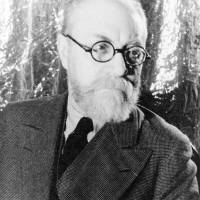
Portrait de Henri Matisse par Car Van Vechten, 1933 - Domaine public, Library of Congress
Henri Matisse was born on December 31, 1869, in Le Cateau-Cambrésis, France, and died in Nice on November 3, 1954. He led the Fauves, rivaled Picasso for half a century, and ended his career by inventing a new medium, the painted paper cut-out. He was also a serious printmaker, with more than 800 prints to his name. If you are thinking about buying a Matisse lithograph or etching, this page explains what he made, who printed it, how the catalog numbers work, and where the market most often blurs the line between original fine art prints and later editions.
At Le Coin des Arts you will find an original lithograph from the Nice years, Le Repos du modèle (1922), alongside color lithographs from the 1958 Verve issue on the cut-outs – Nu bleu debout, Nu bleu aux bas verts, Baigneuse dans les roseaux, Femme à l’amphore, Fleurs de neige, Lierre en fleurs, Grand acrobate – and 2005 lithographs after Jazz, including L’Avaleur de sabres, Le Cœur and Le Lagon. Every sheet is picked for print quality, condition and provenance, and labeled clearly for what it is.
Raised in Bohain-en-Vermandois, Matisse studied law in Paris in 1887 and was working as a clerk when an attack of appendicitis in 1889 kept him in bed long enough to start painting. By 1891 he was in Paris for good, first at the Académie Julian, then in Gustave Moreau’s studio at the École des Beaux-Arts. He made his first etchings and drypoints around 1900. In the summer of 1905 he painted at Collioure with André Derain, and that fall the Salon d’Automne gave the group its nickname: “les fauves,” the wild beasts.
Americans were among his earliest buyers. Leo and Gertrude Stein, followed by Michael and Sarah Stein, bought Woman with a Hat out of the 1905 Salon. In Baltimore, Claribel and Etta Cone began collecting after Etta met Matisse in 1906; their bequest brought roughly 600 works by Matisse to the Baltimore Museum of Art in 1949, prints included. Matisse won first prize at the Carnegie International in Pittsburgh in 1927 and returned as a juror in 1930, the year Albert C. Barnes commissioned the great Dance mural for his foundation in Merion, Pennsylvania (the collection is now in Philadelphia). The Museum of Modern Art gave him a retrospective in 1931 and another in 1951, accompanied by Alfred H. Barr Jr.’s landmark book Matisse: His Art and His Public. Meanwhile his son Pierre Matisse ran one of New York’s defining galleries from 1931 to 1989. It was at Pierre’s urging that Joseph Pulitzer Jr. bought Bathers with a Turtle at the 1939 Lucerne sale of “degenerate” art; the painting is now in the Saint Louis Art Museum.
In Europe, the Moscow collectors Sergei Shchukin – who commissioned Dance and Music (1909-1910, Hermitage) – and Ivan Morozov bought major canvases, including nearly half of the Moroccan paintings from Matisse’s stays in Tangier in 1912 and 1912-1913. From 1908 to 1911 he ran his own teaching studio, the Académie Matisse. In 1917 he moved to Nice, and the 1920s brought the odalisques and his most intense period of lithography. Le Repos du modèle (1922; Duthuit 416), published in 1925 by the Galerie des Peintres-Graveurs, and the Ten Dancers (Dix danseuses, 1925-1926), printed at the Duchâtel shop, show how directly he drew on the stone.
In 1932 Albert Skira published Mallarmé’s Poésies with 29 etchings printed by Roger Lacourière. More illustrated books followed: Pasiphaé (1944) in linocut and the Florilège des Amours de Ronsard (Skira, 1948), lithographed by Mourlot. Cancer surgery in 1941 left Matisse largely bedridden; he moved to Vence in 1943 and began “drawing with scissors.” Jazz (Tériade, 1947), the Chapel of the Rosary at Vence (consecrated in 1951) and the late cut-outs closed his career. MoMA’s Henri Matisse: The Cut-Outs (October 12, 2014 – February 10, 2015), shown first at Tate Modern, brought that final chapter to a new generation. Matisse died in Nice at 84 and is buried in the monastery cemetery at Cimiez, in the hills above the city.
Matisse used nearly every technique: etching, drypoint and aquatint, woodcut and linocut, monotype and lithography. Outside his books he mostly worked in black, often in editions of 25 or 50. The touring show Matisse as Printmaker, organized by the American Federation of Arts with the Pierre and Tana Matisse Foundation, opened at the Baltimore Museum of Art in October 2009 – a museum that, thanks to the Cones, holds more than 400 Matisse prints – before traveling to the Tampa Museum of Art and the Blanton Museum of Art in Austin. Lifetime editions of the 1920s could be larger: the Ten Dancers lithographs were issued in 130 numbered impressions on Arches paper. The definitive catalog is Marguerite Duthuit-Matisse and Claude Duthuit, Henri Matisse: Catalogue raisonné de l’œuvre gravé (Paris, 1983, 2 vols.); a reference like “Duthuit 416” points there. Illustrated books are covered in Claude Duthuit’s 1988 catalog. Two things to know: the 20 plates of Jazz are stencils (pochoirs) made by Edmond Vairel, not lithographs (250 copies signed at the colophon, plus 20 hors commerce, completed September 30, 1947); and the 1958 Verve double issue (vol. IX, nos. 35-36), Dernières œuvres de Matisse 1950-1954, contains color lithographs printed by Mourlot that were published in the magazine, unsigned.
Start with the catalog number. A true original print is listed in Duthuit 1983. No number, no premium price.
Check the signature. Lifetime editions are usually signed in pencil and numbered. A signature printed in the image is not a hand signature.
Know your Verve plates. Authentic 1958 Mourlot lithographs, often beautiful, but never signed or numbered by Matisse. If one shows a pencil signature, walk away.
Jazz after 1947. Plates from the original book are Vairel stencils. Lithographs dated 2005 come from the posthumous reissue by Éditions Anthèse, printed at the Idem studio in Paris (Mourlot’s former workshop). They are decorative, honest and far less expensive.
Condition and paper. Look for full margins, no mat burn, no fading. Some 1920s lithographs exist in two states with different image sizes.
Ask about provenance. An old gallery label, a publisher’s stamp or a documented collection history adds confidence and value. A dealer should tell you exactly which edition a sheet comes from.
Posters. Mourlot exhibition posters are a separate, more affordable category. For more, read our pages on authenticity and framing; UV-filtering glazing is a good idea for the Verve colors.
Each Matisse print we offer is selected on its own merits. Explore related artists: Pablo Picasso, Marc Chagall, Fernand Léger, Georges Braque and Odilon Redon, or browse modern art.
Marguerite Duthuit-Matisse and Claude Duthuit, Henri Matisse: Catalogue raisonné de l’œuvre gravé, Paris, 1983 · Claude Duthuit, Henri Matisse: Catalogue raisonné des ouvrages illustrés, Paris, 1988 · Alfred H. Barr Jr., Matisse: His Art and His Public, Museum of Modern Art, 1951 · Baltimore Museum of Art – Matisse as Printmaker · MoMA – 1951 Matisse exhibition press release · Art Institute of Chicago – Poésies (1932) · Saint Louis Art Museum – Bathers with a Turtle

Secure payment
3DSecure 2.2

Free DHL Express delivery from €1,200
Carefully prepared parcel
Parcel tracking

Shipment insured
for the full value of the artwork, covering theft and damage

Fairest prices
Certificate of authenticity
Two galleries in Paris
Receive an email as soon as a new artwork is added for this artist
Your message has been sent ! We will get back to you as soon as possible.
Please fill in the form if you need further information such
Please fill in your email address, an email will be sent with a link to update your password.
You can now place orders and track your orders.
To save your wishlist, you can log in or create an account :
This is a 100% custom-made frame, carefully crafted by a professional framer. Finishes are available in light oak, white wood or black wood, with or without mat board and plexiglass. Delivery times may vary depending on the order, with an average lead time of 10 days.
This option will be offered during the cart step.