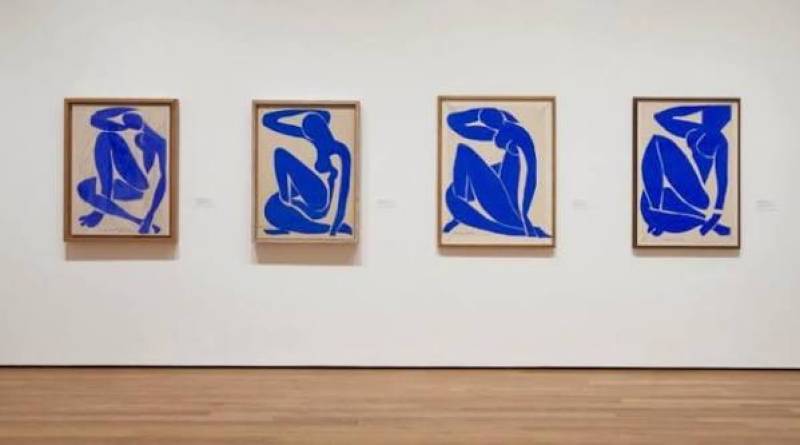
Created in 1952, two years before the artist’s death, the Blue Nudes represent one of the high points of Matisse’s final period and the culmination of a quest pursued for more than half a century around the human figure, colour, and the simplification of forms.
When Matisse embarked upon the Blue Nudes series, he was eighty-two years old. Since the surgical operation he underwent in 1941 following a cancer diagnosis, his mobility had been severely reduced. Yet this ordeal marked the beginning of an extraordinarily productive period. The artist spoke of a “second life”, during which he radically reinvented his means of expression. Unable to work for long periods at the easel, he gradually developed the technique of cut-outs, which would become the defining language of his final years.
Assistants coated sheets of paper with gouache in vivid colours. Matisse then cut them directly with scissors before assembling them onto large supports. He did not regard this process as a substitute for painting, but rather as a new synthesis of drawing and colour. According to his famous expression, he sought to “draw with colour”. This fusion responded to one of the fundamental concerns of his entire career: reconciling drawing and painting within a unified form of expression.
The Blue Nudes thus appear as the culmination of a long meditation on the female body. From the odalisques of the Nice period to the sculptures of the 1910s and 1930s, Matisse continually returned to the seated or reclining figure. In the 1952 cut-outs, the body is reduced to a few fragments of paper whose arrangement alone is sufficient to suggest volume and movement. The artist no longer sought to describe the body in detail but rather to retain its essential lines, following a process of simplification that he had pursued for several decades.
This extreme simplification was not the result of improvisation but of extensive preparatory work. Photographs of the studio reveal that each element was repeatedly moved, pinned into place and adjusted before reaching its final position.
The choice of blue also belongs to a long personal history. It evokes the Mediterranean memories that permeate Matisse’s entire oeuvre: the sea, the sky, and the light of the South.
Finally, while working on the Chapel of the Rosary in Vence, Matisse frequently expressed his admiration for Giotto. He was particularly sensitive to the use of blue in the frescoes of the Scrovegni Chapel in Padua, whose spiritual intensity left a lasting impression on him.
Matisse sought a form of purification capable of reaching the essential, and through his Blue Nudes he achieved an economy of means that stands as one of the major accomplishments of modern art: bringing forth line, colour and light simultaneously in a single creative gesture.

Secure payment
3DSecure 2.2

Free DHL Express delivery from €1,200
Carefully prepared parcel
Parcel tracking

Shipment insured
for the value of the artwork, covering theft and damages
Fairest prices
Certificate of authenticity
Two galleries in Paris
Receive an email as soon as a new artwork is added for this artist
Your message has been sent ! We will get back to you as soon as possible.
Please fill in the form if you need further information such
Please fill in your email address, an email will be sent with a link to update your password.
You can now place orders and track your orders.
To save your wishlist, you can log in or create an account :
This is a 100% custom-made frame, carefully crafted by a professional framer. Finishes are available in light oak, white wood or black wood, with or without mat board and plexiglass. Delivery times may vary depending on the order, with an average lead time of 10 days.
This option will be offered during the cart step.